
Munich Beer Garden Itinerary
A relaxed warm-weather route through Munich's classic beer gardens — from the English Garden's Chinese Tower to the Augustiner-Keller's century-old chestnuts and a riverside finish — with the bring-your-own etiquette, what to order, and the transit that links them.

Photo: Sven Mieke / Unsplash

- ✓A deliberately gentle warm-weather plan built around shade, benches and time — two or three beer gardens across a long afternoon and evening, with walks and the river in between.
- ✓Built on Bavaria's bring-your-own tradition: at the self-service tables of a traditional garden you may bring your own food and buy only the beer — locals arrive with a cloth, a radi and a Brezn.
- ✓Links the classics — the Chinese Tower in the English Garden, the Augustiner-Keller's chestnut-shaded benches, the Viktualienmarkt garden and a riverside finish — by short walks and transit.
- ✓Best from roughly April to October, when the gardens are open and the chestnuts are in leaf; the season and individual hours depend on the weather, so check before you set out.
- ✓Everything here is evergreen; confirm current opening hours, seasons and any reservations before you go, and remember a Maß is a full litre — pace yourself.
How to use this itinerary
A beer-garden day is the most relaxed thing you can do in Munich, and the whole point is not to rush it. This plan strings together two or three of the city's classic gardens across a long afternoon and into the evening, with walks, a river stretch and plenty of bench time in between. It is built for warm, dry weather — roughly April to October — and for a pace closer to lingering than to sightseeing. Think of it as a frame for an unhurried day outdoors, not a schedule to keep.
Before anything else, learn the one rule that makes a Munich beer garden work: the bring-your-own tradition. By long-standing Bavarian custom, the self-service areas of a traditional beer garden — the plain wooden benches, as opposed to the tablecloth-covered served tables — let you bring your own food and buy only your beer. Locals turn up with a chequered cloth, a radi (a spiral-cut white radish, salted to draw out the bite), a Brezn, cold cuts and cheese, and settle in for the afternoon. You can also just buy everything on site; both are completely normal.
A few practicals up front. A Maß is a full litre of beer — order a Halbe (half) or a Radler (beer with lemonade) if a litre feels like a lot, and pace yourself across the day. Many gardens take a deposit (Pfand) on the heavy glass mug; you get it back when you return the empty. Bring cash, as some stands are cash-preferred. And check the day's weather and each garden's current hours before you set off, because beer-garden season and opening both bend to the sky.
Midday: start in the English Garden at the Chinese Tower
Begin where Munich's beer-garden culture is at its most picturesque: the Chinesischer Turm (Chinese Tower) in the English Garden, one of the city's largest and most famous gardens, set under chestnuts around a pagoda-like wooden tower. A brass band often plays from the tower's upper level on fine days, the crowd is a happy mix of students, families and visitors, and the self-service stalls do the full Bavarian range — roast chicken (Hendl), pork knuckle, sausages, Brezn and, of course, the Maß.
Arrive around midday, before the afternoon crowds fill it, and claim a bench in the shade. This is the spot to learn the rhythm of the whole day: order or unpack your food, settle in, and let an hour or two pass with no agenda at all. The English Garden is one of the largest urban parks in the world — bigger than New York's Central Park — so there is endless space to walk the beer off afterwards: north across the meadows to the Kleinhesseloher See, or down to the famous Eisbach standing wave where surfers ride year-round, both an easy stroll from the tower. Bring a layer even on a warm day; the chestnut shade that makes the garden so pleasant in the sun can turn cool by evening, and the whole point of this plan is to stay comfortable enough to linger.
From here you have a choice of routes. If you want a single long, languid session, you could happily stay all day. But the better plan, and the one this itinerary follows, is to make the Chinese Tower the opening act, walk off the first Maß through the park, and move on to a second garden in the late afternoon. Either way, the English Garden is the right place to begin, because everything about it — the dappled shade, the brass band, the easy mix of locals and visitors — sets the tone for the kind of slow, sociable day a beer garden is meant to be.
A note on why the gardens look the way they do, because it explains the whole tradition. The chestnut trees that shade every classic Munich beer garden were planted, centuries ago, to keep the beer cellars dug beneath them cool through the summer before refrigeration existed; brewers would tap and sell the cold beer on the spot, and a custom grew of letting people bring their own food to go with it. When King Maximilian I curtailed the brewers' food sales to protect the city's innkeepers, the right to bring your own bread and cheese was effectively preserved — and that nineteenth-century compromise is why, to this day, you can spread your own picnic on a Munich beer-garden bench and buy only the beer. You are sitting inside a living piece of the city's history.
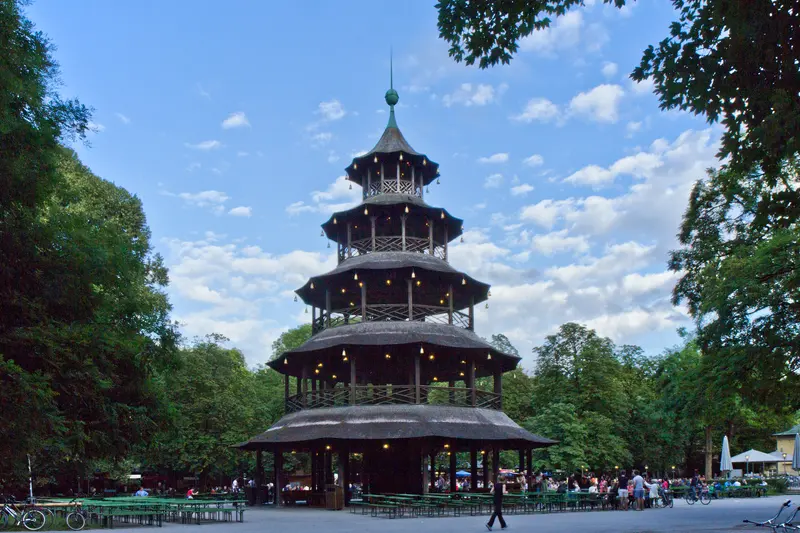 Chinese Tower beer gardenThe full plan for the English Garden's famous garden — seating, the band, food and walking routes.
 The English GardenThe park itself — the Monopteros, the lake, long walks and the Eisbach surfers.
 The Eisbach waveThe standing wave where surfers ride year-round, a short walk from the Chinese Tower.
Mid-afternoon: walk it off, then choose your second garden
The space between gardens is half the pleasure of this day. From the Chinese Tower, walk south through the English Garden, climbing the little hill to the Monopteros, the Greek-style temple with one of the city's loveliest free views over the park and the skyline beyond. Carry on to the southern tip of the garden and you are back at the edge of the Old Town, ready for a second stop — the walk both clears your head and earns the next Maß.
Your second garden depends on what you want from the afternoon. For the most atmospheric and most local of the classics, make for the Augustiner-Keller near the Hauptbahnhof, whose huge garden sits under chestnut trees said to be more than a century old, pouring Augustiner — many Münchners' favourite — from wooden barrels. It is a short tram or U-Bahn ride west, and a strong contender for the single nicest beer garden in the city.
Alternatively, if you'd rather stay central and combine the beer with food shopping, the small beer garden at the Viktualienmarkt — the open-air food market a minute from Marienplatz — is a charming, leafy spot in the middle of the Old Town, and it rotates the beer it serves among the city's breweries through the year. It's smaller and busier than the great gardens, but unbeatable for slotting a Maß between sightseeing and the market's food stalls.
 The MonopterosThe hilltop temple and free viewpoint to climb on the walk between gardens.
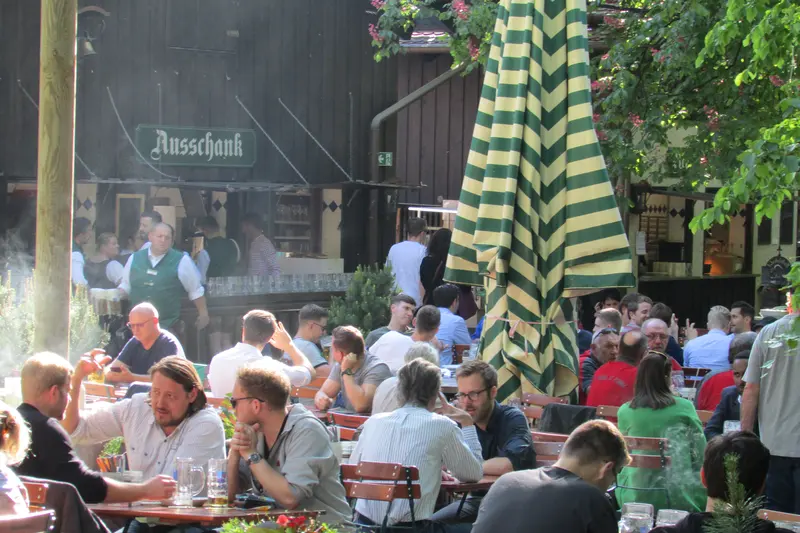 Augustiner-KellerThe century-old chestnut garden and cellar near the station — barrel-poured Augustiner and what to order.
 ViktualienmarktThe Old Town food market and its small central beer garden — the convenient second-stop option.
What to order and the bring-your-own ritual
Ordering is part of the fun, and it is simpler than it looks. The default pour is the Maß, a full litre of Helles (the pale lager that is Munich's everyday beer), but you can ask for a Halbe (a half) or, if a full litre is too much in the sun, a Radler, which is beer cut roughly half-and-half with clear lemonade — the single most refreshing thing on a hot afternoon and not at all frowned upon. Weißbier or Weißbier (cloudy wheat beer, served in its own tall glass) is the other Munich staple, and a Russ' is the wheat-beer version of a Radler. Whatever you order, note whether there's a Pfand — a deposit on the heavy glass mug, paid up front and refunded when you return the empty — and keep the token or the glass to claim it back. At a self-service garden you queue at the beer stand, pay, and carry your own Maß to the bench; at a served table, a waiter brings it. Both are normal; just know which kind of table you've sat at.
For food, you have two equally correct options. Buy from the garden's stalls — roast chicken, Schweinshaxe (pork knuckle), Steckerlfisch (a whole fish grilled on a stick), sausages, Obatzda (a spiced soft-cheese spread) with Brezn — or bring your own to the self-service benches in the true Bavarian style. The classic home spread is a chequered cloth, a radi sliced into a salted spiral, cold cuts, cheese, a Brezn and maybe some Obatzda from the deli. Either way, you only ever buy the beer on site; bringing your own beer is not done.
The etiquette is gentle but real. The served, tablecloth-covered tables are for table service and full meals; the bare wooden benches are self-service and the home of bring-your-own. Don't sit at a reserved (reserviert) table. Sharing a long bench with strangers is normal and friendly — a nod and a 'Servus' goes a long way. Tip modestly if you're served. And clear your spot or return your dishes as the garden expects. None of it is fussy; it just keeps a few thousand people happy under the same trees.
 Bavarian food to tryWhat to order or pack — Obatzda, Brezn, Weißwurst, Schweinshaxe and the rest, explained.
 Munich breweries guideThe six city breweries behind the beer — Augustiner, Paulaner, Hofbräu and the others.
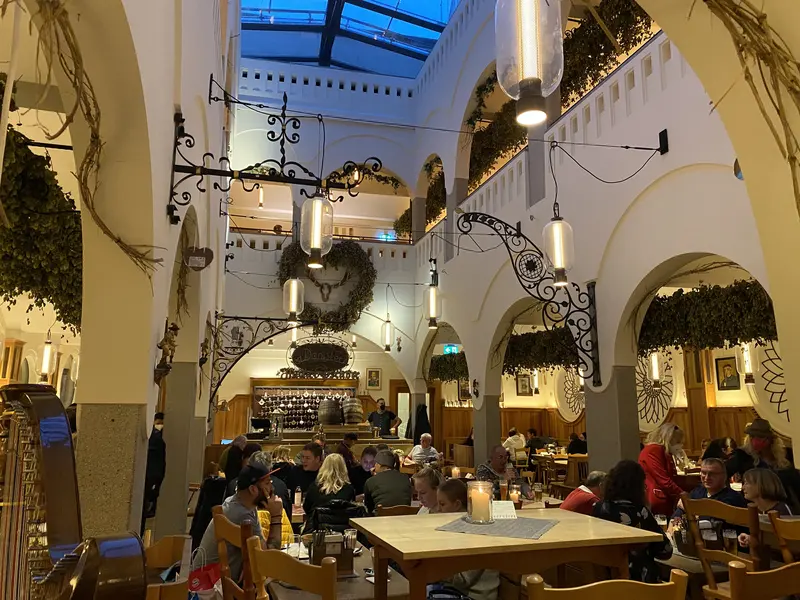 Best beer halls in MunichThe indoor counterpart — where to go if the weather closes the gardens.
Evening: a riverside finish and a rainy-day backup
Close the day where Munich relaxes best: by the water. From a central garden it's an easy walk or short ride to the Isar, where on warm evenings the gravel beaches and grassy banks fill with locals, and a stretch along the river — toward the Glockenbachviertel for dinner and a nightcap — makes the perfect, gentle end to a beer-garden day. If you've kept some energy, the Glockenbachviertel's small bars and restaurants are a fine way to round things off; if you haven't, the riverbank itself is enough.
There are excellent gardens in every direction if you want to extend or swap the route. The Hirschgarten, in the west, is one of the largest beer gardens in the world, seating thousands under old trees, and comes with a fenced deer enclosure that makes it a firm favourite with families. The Seehaus on the Kleinhesseloher See, lakeside in the English Garden, lets you watch rowing boats from your bench; the Paulaner garden on the Nockherberg and the wooded Flaucher on its Isar island give you a more local, less touristy afternoon; and the Löwenbräukeller and Augustiner gardens cover the rest. They all fit the same template — shade, benches, bring-your-own, a Maß — so mix and match by where you're staying, what the weather's doing and where the day happens to drift.
And because this is Munich, have a wet-weather plan. Beer-garden season and daily opening both depend on the weather, so if it turns, move the day indoors to a classic beer hall — the Hofbräuhaus, the Augustiner halls, a Löwenbräukeller — where the same beer, food and long-bench conviviality carry on under a roof. The gardens are the summer version of an institution that runs all year; the rain just sends it inside.


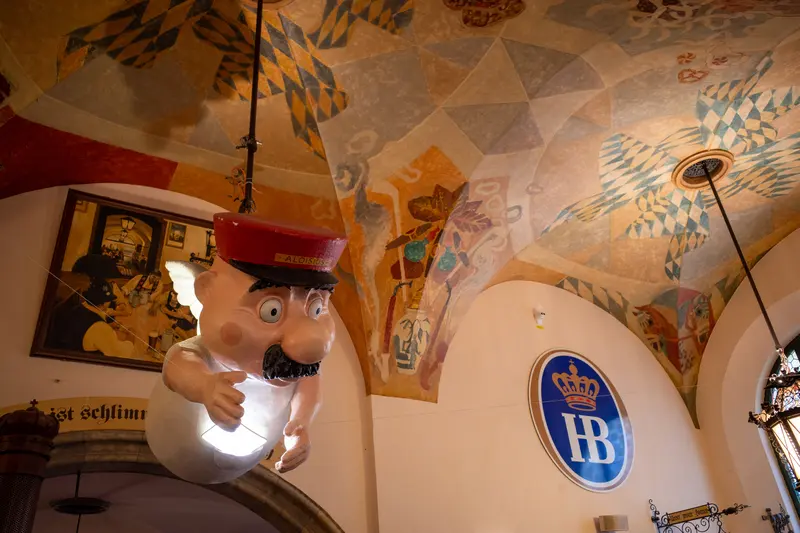
The unwritten rules of sharing a bench
Part of what makes a Munich beer garden so disarming is that it is genuinely communal, and a few unwritten courtesies keep it that way. The long benches are shared: if there's a gap, you sit in it, even alongside strangers, and a friendly 'Ist hier noch frei?' ('is this still free?') is all the introduction anyone expects. People shuffle up without being asked, conversations strike up across the table or they don't, and nobody minds either way. It is one of the most sociable, unpretentious public spaces in Europe, and leaning into that — rather than hunting for an empty table to yourselves — is half the pleasure.
A handful of other conventions are worth knowing. Keep to the self-service benches if you're bringing your own food; the served, tablecloth-covered tables are for those ordering from a waiter, and sitting there with a home-packed picnic is the one real faux pas. Tidy up after yourselves and return your heavy glass mugs to the wash station to reclaim the Pfand deposit. Dogs are welcome and common under the tables, children run freely between them, and the whole scene runs on an easy, self-policing good humour. Observe those small courtesies and you slot straight into the rhythm; ignore them and a local will gently put you right, usually with a smile.
More gardens to build the day around
Munich has dozens of beer gardens, and part of the fun of a longer stay is matching the garden to the mood. The Hirschgarten, west of the centre near Nymphenburg, claims to be the largest beer garden in the world, with seating for thousands under old trees and a fenced deer enclosure that delights children — it's the move for a big, sprawling, family-friendly afternoon, and it pairs beautifully with a morning at Nymphenburg Palace and its park next door.
In the English Garden, beyond the Chinese Tower, the Seehaus garden sits right on the Kleinhesseloher See, where you can hire a rowing boat and watch the water from your bench — the prettiest setting of all on a still evening. South of the river, the Paulaner garden on the Nockherberg and the Flaucher, on a wooded island in the Isar, give you a more local, less touristy afternoon, the Flaucher especially beloved by Münchners who cycle out with their picnics.
For pairing gardens with sights, a few combinations work especially well: the Viktualienmarkt garden with an Old Town morning; the Augustiner-Keller with the museums of the nearby Kunstareal or a day around the station; the Chinese Tower with a full English Garden walk; and the Hirschgarten with Nymphenburg. Build your day around one anchor garden and a nearby sight, add a second garden if the weather holds, and let the walk between them do the pacing. There's no wrong order — only the weather, your appetite and how long you want the afternoon to run.
 Nymphenburg ParkThe palace park beside the giant Hirschgarten — a natural morning before a sprawling garden afternoon.Best things to do in MunichThe wider sights to anchor a garden day on — pick one near the garden you fancy.Things to do in MunichThe headline-sights hub, to weave a beer-garden afternoon into a fuller day in the city.
Practicalities: season, transit and pacing yourself
Beer-garden season in Munich runs roughly from spring to autumn — broadly April to October — and individual gardens open and close around the weather, so a cold or wet spell can shorten the day even within the season. Always check the specific garden's current hours and whether it's open before you build a plan around it. The big classics keep long hours on fine days; the smaller ones can be more weather-dependent. None of this is fixed in stone, which is exactly why a beer-garden day rewards a glance at the forecast.
Getting between the gardens is simple. The English Garden's Chinese Tower, the Augustiner-Keller, the Viktualienmarkt garden, the Hirschgarten and the Isar are all linked by short walks plus the U-Bahn, S-Bahn and trams, and one MVV day ticket covers the lot — and usually beats buying singles. Walking the stretches you can is part of the plan, both for the views and to space out the beer. Bring cash for the stands that prefer it, and remember the Pfand deposit on the mugs.
Finally, pace yourself — a litre at a time, in the sun, adds up faster than it seems. Alternate beers with water, lean on the Radler and the Halbe, and eat properly along the way. A beer-garden day done well is long, mellow and entirely pleasant; done too fast it is short and regrettable. Confirm current hours, seasons and any reservations against official sources before you go, keep the pace gentle, and let the afternoon do the rest.


At a glance
What it covers: a relaxed warm-weather route through two or three of Munich's classic beer gardens.
Midday: start at the Chinese Tower in the English Garden — shade, a band on fine days, the full Bavarian spread.
Afternoon: walk off the first Maß via the Monopteros, then move to the Augustiner-Keller or the Viktualienmarkt garden.
Evening: a riverside finish along the Isar toward the Glockenbachviertel, with a beer hall as the rainy-day backup.
Order: a Maß (litre), a Halbe (half) or a Radler; bring your own food to the self-service benches, buy only the beer.
Best for: warm, dry days from spring to autumn, and anyone who wants to slow Munich right down.
- Bring your own food to the bare wooden self-service benches — buy only the beer; never bring your own beer.
- A Maß is a full litre; pace yourself with a Halbe or a Radler and plenty of water.
- Mind the Pfand (mug deposit), bring some cash, and don't sit at reserved (reserviert) tables.
- Season runs roughly April–October and bends to the weather — check current hours and have an indoor backup.

Best Beer Gardens in Munich
A seasonal guide to Munich's classic beer gardens — the chestnut-shaded benches, the bring-your-own rule, what to order, and which gardens suit families, dates or a quiet pint.
Read guideChinese Tower Beer Garden, Munich
Plan the English Garden's most famous beer garden — the wooden pagoda, the brass band, the self-service benches and the bring-your-own rule, plus the prettiest walking route in.
Read guide
Munich Beer Garden Etiquette
How a Munich beer garden actually works — the self-service vs served split, the bring-your-own rule, table sharing, reservations, tipping, toasting and clearing your own glass.
Read guideMore in Itineraries
6
A Weekend in Munich
A Friday-to-Sunday weekend in Munich planned the way a city break actually runs — arrival-evening logic, a full Saturday of sights and gardens, a slower Sunday that works around the shops being shut, with hotel-area, dinner-timing and no-wasted-transit advice throughout.
Read guide
Four Days in Munich
A slower four-day Munich itinerary that adds the things three days has to skip — a proper neighbourhood day, more museums and beer gardens, and one big day trip into the Alps or to the lakes — built for travellers who want to live the city rather than tick it off.
Read guide
Local Munich Beyond the Old Town
Where Munich actually lives once you've seen Marienplatz — the village-feel neighbourhoods, the riverside, the local cafés and markets, the parks and the beer gardens that locals fill, with a route to weave them into a slower second or third day.
Read guide
Luxury Munich Itinerary
A high-end, unhurried plan for Munich — grand-dame and design hotels, private guides, fine dining, palaces and treasuries, the opera, and an Alpine or lakeside add-on, built around comfort and time rather than a packed schedule.
Read guide
Munich Airport Layover Guide
How to spend a layover at Munich Airport — when a dash into the city is realistic, how long you really need, what to do without leaving, and when it's smarter to stay near the terminals.
Read guide
Munich Art & Museums Itinerary
A rain-proof culture itinerary for Munich — a focused day in the Kunstareal among the Pinakotheken and the Blue Rider, a science day at the Deutsches Museum, and a cars-and-modern-architecture option around BMW and Olympic Park, with how to pair them without museum fatigue.
Read guide