
Munich Christmas Market Itinerary
A festive route through Munich's Christmas markets — from the grand Marienplatz Christkindlmarkt and the medieval and Kripperl markets of the Old Town to the artier Tollwood at the Theresienwiese — with skating, market food, Glühwein and warm indoor breaks worked in.

Photo: Jahanzeb Ahsan / Unsplash

- ✓A festive day-and-evening plan that strings together Munich's distinct Christmas markets — the grand Marienplatz Christkindlmarkt, the Old Town's quirkier markets, and the alternative Tollwood — with warm indoor breaks built in.
- ✓The Marienplatz Christkindlmarkt fills the central square from late November to Christmas Eve, with Glühwein and a great decorated tree beneath the lit New Town Hall — verify the current year's dates and closing day before you plan.
- ✓Built for cold, dark afternoons: markets look their best at dusk as the lights come on, so this plan front-loads daylight sightseeing and saves the markets for the magical evening hours.
- ✓Glühwein (mulled wine) usually comes with a Pfand — a deposit on the souvenir mug, refunded when you return it, or kept as a keepsake; a Kinderpunsch is the non-alcoholic version.
- ✓Everything here is evergreen; confirm the current season's dates, hours, skating-rink and market locations before you go — markets and rinks shift slightly year to year.
How to use this itinerary
Munich at Christmas is one of the loveliest versions of the city, and the trick to enjoying it is to lean into the season's natural rhythm rather than fight the short, cold days. In December the light goes early — the sun is low by mid-afternoon and gone soon after four — so the smart move is to flip the usual sightseeing order. This plan front-loads the daylight hours with indoor sights and warm stops, then saves the markets for the late afternoon and evening, because a Christkindlmarkt is at its most magical precisely at dusk, when the lights flick on, the Glühwein steams in the cold air, and the whole square begins to glow. Fighting that rhythm — trudging round outdoor markets in the flat grey of midday and saving museums for the evening when they have closed — is how visitors end up cold and underwhelmed. Treat this as a frame for a festive day, not a tight schedule.
Munich doesn't have one Christmas market but several, each with its own character, and the joy is in the contrast. The grand, traditional Christkindlmarkt on Marienplatz is the centrepiece; a short walk away the Old Town hides smaller, quirkier markets — a medieval one, a craft-and-Nativity (Kripperl) market, and the bohemian Pink Christmas in the Glockenbachviertel; and out at the Theresienwiese, the Tollwood winter festival offers an artier, world-music, eco-minded alternative. This itinerary links the best of them.
A few practicals up front. The main markets typically run from late November to Christmas Eve (the 24th), though Tollwood and a couple of others stretch differently, so always check the current year's dates and daily hours before you go. Dress seriously warm — layers, a hat, gloves, good boots — because you'll be outdoors after dark. Bring some cash for the stalls. And know the Glühwein ritual: it comes with a Pfand (a mug deposit) you get back on return, or pay to keep the cup as a souvenir. Kinderpunsch is the alcohol-free version for children or non-drinkers.
Daytime: warm sights before the markets open up
Start the festive day indoors and in daylight, saving the cold evening hours for the markets. Munich's winter sights are made for this: a long café breakfast with a slice of Stollen, then a museum or a palace to fill the bright but chilly middle of the day. The Residenz, the Pinakothek galleries in the Kunstareal, or the Deutsches Museum all make warm, rich daytime anchors that leave you ready to brave the cold later.
Work in the Old Town's festive set-pieces while the light lasts. Marienplatz is the obvious heart — the neo-Gothic New Town Hall, the Glockenspiel at 11:00, and the great Christmas tree and market stalls already taking shape across the square. Climb the tower of St. Peter's (Alter Peter) opposite for a rooftop view straight down onto the market and out over the snow-dusted city, which is one of the best photographs of the entire season and a far quieter experience than jostling at street level. The twin-domed Frauenkirche, the gilded Asamkirche and the Old Town's other churches make calm, warm refuges between stops — somewhere to thaw your hands and quiet the crowds for ten minutes — and several hold their own Advent concerts. Slot one or two of these in, and the daytime never feels like dead time before the markets.
Have a proper hot lunch indoors — this is the season for the city's beer halls and traditional restaurants, where Schweinshaxe, roast goose or duck with red cabbage and dumplings, and a warming bowl of Leberknödelsuppe (liver-dumpling soup) set you up for the cold. Winter is arguably when Munich's hearty Bavarian cooking makes the most sense, and a long, warm midday meal is exactly the foundation a market evening needs. The point of the daytime is to see the city and store up warmth before the markets become the main event; come dusk, everything shifts outdoors, and you'll be glad of the fuel.
 MarienplatzThe central square and the Christkindlmarkt's home — the New Town Hall, the Glockenspiel and the great tree.
 St. Peter's towerThe rooftop climb for the season's best view over the lit market and the winter city.
 Indoor MunichMuseums, palaces, halls and warm cafés — the daytime refuges for a cold festive day.
Dusk: the Marienplatz Christkindlmarkt and the Old Town markets
As the light fades, make for Marienplatz and the Christkindlmarkt, Munich's grand traditional market and the centrepiece of the whole season — the square has hosted a Christmas market in some form for centuries, and it remains the city's festive heart. The whole of Marienplatz fills with wooden stalls under a great decorated Christmas tree, often donated from the Alps and strung with thousands of lights, all framed by the floodlit neo-Gothic New Town Hall, which is about as cinematic a backdrop as a market gets. On many evenings during Advent, live Christmas music — carols, brass ensembles, choirs — plays from the Rathaus balcony above the crowd. Wrap your gloved hands around a steaming Glühwein, drift between the stalls of hand-blown ornaments, beeswax candles, carved wooden figures and Lebkuchen (gingerbread), and let dusk do its work — this is the photograph everyone comes for, and standing in the middle of it, it earns every bit of its reputation.
Don't stop there, because the Old Town hides several smaller, more characterful markets within a few minutes' walk. The Mittelaltermarkt (medieval market) trades in a candlelit, costumed setting with mead, blacksmiths and minstrels, a complete change of register from the polished central market; the Kripperlmarkt specialises in the carved Nativity figures and hand-built cribs (Krippen) that are one of Bavaria's deepest Christmas traditions, with whole stalls of tiny shepherds, animals and stable pieces to build a scene at home; and there are craft and design markets tucked into courtyards and side squares all across the centre. Part of the magic is how close together they sit: in a single evening on foot you can pass from the grand civic spectacle of Marienplatz to a candlelit medieval lane and a quiet craft courtyard, each with its own crowd, food and mood. Wandering between them, mug in hand, with the cold sharpening every smell of cinnamon and roasting almonds, is the real, unhurried pleasure of a Munich Christmas evening.
For something different again, the Glockenbachviertel's Pink Christmas is the city's LGBTQ+ and alternative market, smaller and more bohemian, a warm and welcoming counterpoint to the grandeur of Marienplatz. The beauty of doing this on foot is the contrast: in one evening you can pass from a vast civic spectacle to a candlelit medieval lane to a cosy neighbourhood square, each with its own crowd, food and mood.
 Christmas market foodWhat to eat and drink — Glühwein, Lebkuchen, roasted chestnuts, sausages and the sweet stalls.
 GlockenbachviertelThe lively quarter home to the bohemian Pink Christmas market and its bars and restaurants.
 Christmas romance in MunichThe festive city for couples — the prettiest market corners, lights and warm dinners.
What to eat and drink at the markets
Glühwein is the headline act — hot spiced red wine, ladled steaming into a mug that carries a Pfand (deposit) you reclaim on return, or pay to keep as a souvenir; collectors end the season with a shelf of them. There's white Glühwein too, often fruitier, and harder pours like Feuerzangenbowle, where a rum-soaked sugarloaf is set alight over the wine. For children and non-drinkers, Kinderpunsch is the warm, spiced, alcohol-free version, and just as good in the cold.
The food is half the reason to come, and the savoury stalls are as important as the sweet. Bratwurst and other grilled sausages tucked into a crusty roll, Käsespätzle (cheesy egg noodles) ladled hot from the pan, roasted chestnuts (Maroni) sold warm by the bag, Kartoffelpuffer (potato pancakes) with apple sauce, and the steamed sweet dumplings — Dampfnudeln and Germknödel — that are a Bavarian winter staple. Then the sweet stalls, heaped with Lebkuchen hearts iced with messages, candied roasted almonds (gebrannte Mandeln) whose smell drifts across the whole market, Schokofrüchte (chocolate-dipped fruit), Stollen and crêpes. Eating your way slowly along a row of stalls, mug in one hand and something warm in the other, is exactly how a market evening is meant to go — graze rather than sit down, and let the cold give you an appetite.
Beyond eating, the markets are the place for tasteful Christmas shopping: hand-blown glass ornaments, beeswax candles, carved wooden Nativity figures, Bavarian crafts and decorations you won't find at home. Bring cash, as many small stalls prefer it. And pace the Glühwein — it's stronger and warmer than it tastes in the cold, and a slow mug or two across an evening beats a quick few. As ever, prices and exactly which stalls appear vary year to year, so take this as the flavour of it rather than a fixed menu.
Christmas market foodThe full guide to market eating and drinking — the must-tries, the sweets and the Glühwein ritual. Munich souvenirsTasteful things to buy — including the ornaments, crafts and food gifts the markets do best.
 Bavarian food to tryThe wider Bavarian table — the warming dishes for an indoor lunch between markets.
Tollwood, skating and the warm-up breaks
Set aside one evening for something other than the traditional markets. The Tollwood Winter Festival, out at the Theresienwiese (the Oktoberfest grounds), is Munich's big alternative: a tented festival of world music, performance, an artisan and global market, and a strong focus on organic food and sustainability. It's livelier, more international and more programmed than the Old Town markets — live acts, a different crowd, a market with a global rather than purely Bavarian flavour — and it usually runs on a slightly different, longer schedule, so check its current dates and any ticketed events.
Skating is the other classic festive add-on. Munich sets up seasonal ice rinks in winter — the location and exact arrangements shift year to year, with Karlsplatz (Stachus) a long-running favourite among the spots that have hosted one — so check where the current rink is before you plan around it. An hour on the ice, then a Glühwein to warm up, is one of the season's simplest pleasures, and a fine thing to do with children.
Above all, build in warm-up breaks — this is the make-or-break of a Christmas market trip. After every hour or so outside, duck into a café for a hot chocolate, a beer hall for a warming meal, or a church for the quiet and the cold off your face. The markets are wonderful precisely because you step out of the cold and back into it; the indoor pauses aren't an interruption to the festive day, they're part of its pleasure. Plan them in, and you'll last the whole magical evening.
 Karlsplatz (Stachus)The Old Town gateway square and a long-running winter ice-rink location — verify the current rink.
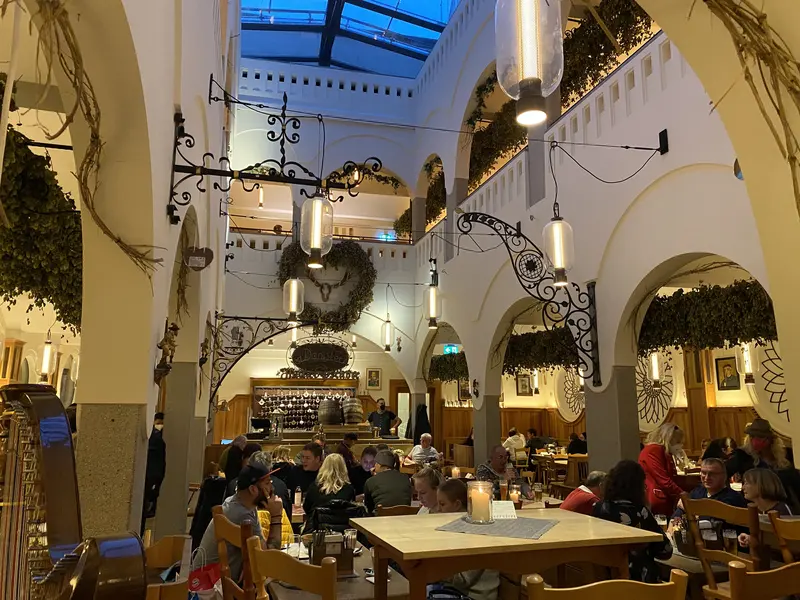 Best beer halls in MunichThe warm indoor refuges between markets — hearty food and a roof over your head.
 Best coffee in MunichWhere to take the warm-up break — hot chocolate, coffee and a slice of Stollen.
Neighbourhood markets and quieter corners
Beyond the famous central markets, Munich's neighbourhoods each run their own smaller Christmas markets, and seeking these out is how you escape the busiest crowds and see how locals actually do the season. Schwabing's market along Münchner Freiheit, the markets in Haidhausen's village-like Weißenburger Platz and Bordeauxplatz, and the small squares of the Glockenbach and Isarvorstadt all have a gentler, more residential feel — fewer visitors, more neighbours, and stalls run by local makers. They reward a wander on a quieter afternoon, especially if your hotel is nearby.
A handful of markets specialise in a particular flavour worth seeking out. The Medieval Christmas Market trades in a candlelit, costumed, mead-and-crafts setting that feels centuries old; the Pink Christmas in the Glockenbachviertel is the warm, bohemian LGBTQ+ market; and various craft and design markets tuck into courtyards across the city for a more curated kind of shopping. The Tollwood festival's market, out at the Theresienwiese, leans organic, global and artisan. Between them, you could spend several evenings and never see the same market twice.
If you're travelling as a couple, the markets are quietly one of the most romantic things Munich offers in winter — a shared Glühwein under the lights, the snow-dusted Old Town, the small candlelit lanes, a horse-drawn carriage if one's running. If you're with children, lean on the funfair-style rides some markets set up, the Kinderpunsch, the carved Nativity figures, the roasted chestnuts and the skating. The season scales beautifully to whoever you're with — which is part of why a Munich Christmas trip lands so well.
 SchwabingThe bohemian northern district and its Münchner Freiheit market — a quieter neighbourhood option.
 HaidhausenThe village-like quarter east of the river, with small, local Christmas markets on its squares.
 Munich couples itineraryThe romantic version of a Munich trip — to fold the festive markets into a couple's weekend.
Dressing for it: how to stay out all evening
A Munich Christmas market is an outdoor evening in a cold continental winter, and how warmly you dress is the single biggest factor in whether you last three happy hours or retreat shivering after forty minutes. December temperatures routinely sit around or below freezing once the sun drops, and the markets are at their most magical after dark, so the trick is to dress as if you're going to stand still outside for the whole evening — because you largely will. Layers are everything: a warm base layer, a jumper, and a genuinely windproof, insulated coat over the top, finished with a hat, gloves and a scarf. The detail most visitors underestimate is their feet — thick socks and proper insulated boots make the difference between comfort and misery, because cold rises through the cobbles fast when you're standing at a Glühwein stall.
The good news is that the markets are designed to help you keep warm from the inside. A hot Glühwein or a Kinderpunsch served in a souvenir mug warms your hands as much as your spirits, the roasted-chestnut and grill stands throw out genuine heat, and there's no shame in cycling between the market and a nearby café, church or department store to thaw out every so often — locals do exactly this. Plan your evening around those warm-up breaks rather than trying to power through, hold your mug for the heat as much as the drink, and you'll comfortably stay out long enough to see the Old Town markets light up, empty of the early crowds, at their most beautiful.
Practicalities: dates, warmth, transit and a couple of days
Timing is everything with a Christmas-market trip. The main markets, including the Marienplatz Christkindlmarkt, typically open in late November and close on Christmas Eve (the 24th), so a visit between Advent and the 24th catches them in full swing — but they're gone by Christmas Day itself, which surprises some visitors. Tollwood and a few others keep different, sometimes longer schedules. Dates and daily hours shift year to year, so confirm the current season's calendar before you book, and don't assume anything is open on the 25th.
Dress for being outdoors in the cold and dark for hours: proper layers, a warm hat, gloves, a scarf and waterproof boots, because Munich Decembers can be genuinely cold and sometimes snowy or wet. The markets are mostly clustered in and around the Old Town, walkable from each other, with Tollwood out at the Theresienwiese a short U-Bahn ride away — one MVV day ticket covers the transport, and usually beats buying singles. Expect the central markets to be busiest at weekends and after work; weekday afternoons are calmer.
Over a couple of days this plan expands easily. Day one: daytime sights and the Marienplatz-plus-Old-Town markets in the evening. Day two: a museum or a palace by day, a skating session, and the Tollwood festival or a different cluster of markets after dark, with a warm festive dinner to finish. Keep the daytimes flexible for the weather, protect the warm-up breaks, and confirm current dates, hours and locations against official sources before you go — a Munich Christmas done at this gentle, well-warmed pace is about as festive as travel gets.

At a glance
What it covers: a festive route through Munich's Christmas markets, with skating, market food and warm indoor breaks.
Daytime: warm sights and museums while it's light — the Residenz or a gallery, plus the Old Town and a tower view.
Dusk: the grand Marienplatz Christkindlmarkt, then the Old Town's medieval, Nativity and Pink Christmas markets on foot.
Another evening: the alternative Tollwood festival at the Theresienwiese, plus a seasonal skating session.
Eat and drink: Glühwein (mind the Pfand mug deposit), Lebkuchen, roasted chestnuts, sausages and Kinderpunsch for kids.
Best for: cold-weather visitors who'll save the markets for the magical dusk hours and build in warm-up breaks.
- Main markets run roughly late November to Christmas Eve (the 24th) and close before Christmas Day — verify current dates.
- Markets glow best at dusk; front-load daylight sightseeing and warm indoor stops, then head out as the lights come on.
- Glühwein comes with a Pfand mug deposit (refunded or kept as a souvenir); Kinderpunsch is the alcohol-free version.
- Dress seriously warm, bring cash, use an MVV day ticket, and plan a warm-up break every hour or so.

Munich Christmas Markets
The full guide to Munich's Christmas markets — the grand Marienplatz Christkindlmarkt and the smaller, more characterful markets worth seeking out, when the season runs, how to dodge the crowds, what to eat and drink, and how to time a winter trip and its hotel around them.
Read guide
Munich in December: Christmas Markets, Lights and Festive Bavaria
December is Munich at its most magical — the Christkindlmarkt glowing on Marienplatz, Glühwein under a towering lit tree, palaces and churches dressed for winter, and the whole city wrapped in lights and the smell of roasted almonds. Here's what to expect from the weather, what's on, what to eat, and how to plan a festive Munich trip well.
Read guideMunich Christmas Market Food
What to eat and drink at Munich's Christmas markets — from the centrepiece Glühwein and its souvenir mug to roasted almonds, Lebkuchen and stollen on the sweet side, and the grilled sausages, potato pancakes and Käsespätzle that keep you warm on the savoury one, with the order of attack that makes a market evening a proper winter meal.
Read guideMore in Itineraries
6
A Weekend in Munich
A Friday-to-Sunday weekend in Munich planned the way a city break actually runs — arrival-evening logic, a full Saturday of sights and gardens, a slower Sunday that works around the shops being shut, with hotel-area, dinner-timing and no-wasted-transit advice throughout.
Read guide
Four Days in Munich
A slower four-day Munich itinerary that adds the things three days has to skip — a proper neighbourhood day, more museums and beer gardens, and one big day trip into the Alps or to the lakes — built for travellers who want to live the city rather than tick it off.
Read guide
Local Munich Beyond the Old Town
Where Munich actually lives once you've seen Marienplatz — the village-feel neighbourhoods, the riverside, the local cafés and markets, the parks and the beer gardens that locals fill, with a route to weave them into a slower second or third day.
Read guide
Luxury Munich Itinerary
A high-end, unhurried plan for Munich — grand-dame and design hotels, private guides, fine dining, palaces and treasuries, the opera, and an Alpine or lakeside add-on, built around comfort and time rather than a packed schedule.
Read guide
Munich Airport Layover Guide
How to spend a layover at Munich Airport — when a dash into the city is realistic, how long you really need, what to do without leaving, and when it's smarter to stay near the terminals.
Read guide
Munich Art & Museums Itinerary
A rain-proof culture itinerary for Munich — a focused day in the Kunstareal among the Pinakotheken and the Blue Rider, a science day at the Deutsches Museum, and a cars-and-modern-architecture option around BMW and Olympic Park, with how to pair them without museum fatigue.
Read guide