
Schwabing, Munich
Munich's old bohemian quarter against the English Garden — Jugendstil façades, café and café-bar culture, leafy streets, and an easy, green base a short ride north of the centre.

Photo: I Do Nothing But Love / Unsplash

- ✓Schwabing was Munich's legendary artists' and writers' quarter around 1900 — the Jugendstil (Art Nouveau) capital of the city and home, at various times, to a who's-who of Central European culture.
- ✓It runs right up against the English Garden, so green space and the Eisbach are quite literally on its doorstep.
- ✓The streets are leafy and handsome, with some of Munich's prettiest turn-of-the-century façades, especially around the Gisela- and Friedrichstraße area.
- ✓It's café and wine-bar territory rather than beer-hall territory — relaxed, a little stylish, and good for long evenings.
- ✓A calm, well-connected residential base on the U3/U6 line, a few minutes north of the Altstadt and right by the university quarter.
The bohemian legend, and what's left of it
Few Munich neighbourhoods carry as much myth as Schwabing. Around the turn of the twentieth century this was the bohemian heart of the city — the German-speaking world's answer to Montmartre — where painters, writers and revolutionaries crowded into cheap rooms and smoky cafés. Thomas Mann, Wassily Kandinsky, Paul Klee, Rainer Maria Rilke and Frank Wedekind all passed through; the satirical magazine Simplicissimus was born here; and the whole "Schwabing" idea became shorthand for artistic, slightly rebellious Munich. The neighbourhood had a second countercultural flowering in the 1960s, and the legend has clung to it ever since.
The honest caveat is that the wild bohemia is long gone. A century of success has made Schwabing one of Munich's more comfortable, well-heeled residential districts — the garrets are now sought-after apartments and the rents are anything but bohemian. But the physical beauty that drew the artists is very much intact: this remains one of the loveliest parts of central Munich to simply walk, with broad tree-lined streets and a wealth of ornate Jugendstil (Art Nouveau) façades, all curling stucco, painted bays and wrought-iron balconies. The area around Gisela- and Friedrichstraße is particularly rich in them.
So come for atmosphere and architecture rather than edge. Schwabing today is leafy, prosperous and pleasant — a place to amble, sit in cafés and admire the buildings — with just enough of its old spirit lingering in the bookshops, the café-bars and the proximity to the university to keep it from feeling merely smart.
The English Garden on your doorstep
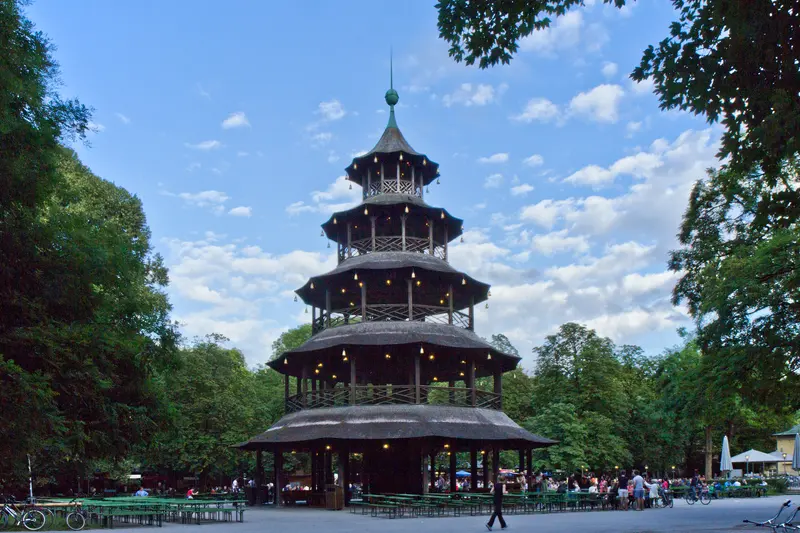
Schwabing's single greatest asset is the one you can't book a table at: the English Garden runs along its eastern edge, so one of the largest urban parks in Europe is effectively the neighbourhood's back garden. From much of Schwabing you can be on the meadows within a few minutes' walk, and the park's defining attractions — the surfers riding the standing Eisbach wave near the southern entrance, the Monopteros hill for sunset, the Chinesischer Turm beer garden under its pagoda — are all within easy reach.
This proximity shapes how the neighbourhood feels and how you'd use it. A classic Schwabing day folds the two together: coffee and a wander among the Jugendstil streets in the morning, the park in the afternoon — a long walk through the meadows, a beer at the Chinese Tower, the light going down from the Monopteros — and back to a café-bar for the evening. For a green, unhurried read of Munich, it's hard to beat having the city's great park one street over.
It also makes Schwabing a fine base for joggers, cyclists and anyone travelling with children or simply craving open space — a rare thing to have on tap in a central city neighbourhood.
Cafés, café-bars and evenings out
Where the Altstadt does beer halls, Schwabing does cafés and café-bars. The neighbourhood's social life runs on long mornings over coffee and unhurried evenings over wine, cocktails or a casual dinner — relaxed and a little stylish rather than rowdy. The crowd skews a mix of well-off locals, students from the nearby university quarter and a creative-professional set, which keeps the cafés busy and the dining varied: Italian and international as much as Bavarian, with plenty of pavement seating in the warmer months.
The traditional artery is Leopoldstraße, the broad boulevard running north through the district, lined with cafés and busiest in summer when the terraces spill onto the pavement; it's the obvious place to people-watch over an Aperol, even if it's more mainstream than hidden-gem these days. For something with more character, the side streets — around Münchner Freiheit, Wedekindplatz and the smaller squares — hold the cosier bars and neighbourhood restaurants. Münchner Freiheit is the area's transport and social hub and a good orientation point.
It's worth setting expectations: Schwabing is lively in an easygoing café-society way, not a late-night-clubbing way. For a big night out you'd still head down to the Glockenbachviertel. But for a pleasant dinner and a drink in handsome surroundings, it delivers reliably, and the green calm of the nearby park makes the contrast feel restorative rather than dull.


Where to stay, and who it suits
As a base, Schwabing trades a little distance from the headline sights for greenery, good looks and calm. It sits a few minutes north of the Altstadt on the U3/U6 line, so the centre, the Hauptbahnhof and Marienplatz are all a short, easy ride — and the museum quarter of Maxvorstadt is right alongside, walkable. Wake up here and you can be among the Pinakotheken or in the English Garden within minutes, and in the old town not long after.
Accommodation is largely mid-range and upper-mid-range hotels with a residential, neighbourhood feel rather than a parade of big chains — fitting for a district that is, at heart, a smart place to live. (As always, specific hotels, rates and availability shift constantly, so check current listings and prices when you book.) The main trade-off is simply that you're not in the thick of the old town: a wonderful thing if you want quiet and green at the end of the day, slightly less convenient if you want every sight on your doorstep.
Choose Schwabing if you want a leafy, attractive, easygoing base with the English Garden alongside and a strong café-and-café-bar scene — and you're happy to ride a few stops in for the central sights and the bigger nights out. It's one of the most pleasant places in Munich to come back to at the end of a day.

Architecture, the Jugendstil streets and quiet corners
If you take one thing slowly in Schwabing, make it the architecture. The turn-of-the-century building boom that coincided with the district's artistic heyday left it rich in Jugendstil — the German strand of Art Nouveau — and the façades are among the finest in the city: flowing stucco ornament, painted floral panels, deep bay windows and wrought-iron balconies, all designed to be admired from the street. The blocks around Ainmillerstraße, Gisela- and Friedrichstraße are especially celebrated; some individual houses are minor landmarks in their own right, and a few carry plaques noting the artists and writers who once lived behind them.
The pleasure of Schwabing is partly in the contrast between its broad, busy boulevards and its quiet residential pockets. Step a street or two off Leopoldstraße and the traffic falls away into calm courtyards, small leafy squares and the kind of handsome, unhurried streets where the loudest sound is a café conversation. Look out for the green breathing spaces, too — small parks and the gardens of the side streets — that keep the district feeling open and liveable rather than merely smart.
It's an area best appreciated on foot and without a fixed plan: turn down whichever street looks prettiest, look up at the façades, and let the neighbourhood's faded bohemian elegance reveal itself building by building. For lovers of architecture and atmosphere, it's one of the most rewarding walks in Munich, and it costs nothing.

Orientation and getting around
Schwabing is long and roughly oriented north–south, following Leopoldstraße up from the Siegestor — the triumphal arch that marks the old boundary with Maxvorstadt — toward the suburbs. The English Garden walls it on the east; Maxvorstadt and the university border it to the south. The two squares to know are Münchner Freiheit, the lively northern hub with its U-Bahn station and café cluster, and the Siegestor/Universität end, where the district shades into the museum quarter. Hold those in mind and the geography falls into place.
Getting in and out is simple: the U3 and U6 run the length of the district underground beneath Leopoldstraße, with Giselastraße, Münchner Freiheit and Universität the most useful stops, putting Marienplatz and the centre just a few minutes south. Trams and buses fill in the gaps, and the flat, leafy streets are a pleasure to cover on foot or by bike — riding into the English Garden from here is effortless.
For a first wander, walk the Jugendstil streets between Giselastraße and Münchner Freiheit, cut east into the English Garden for a loop past the Chinese Tower, and come back out for a coffee or an evening drink. It's an easy, green half-day that shows you exactly what the neighbourhood is for.

A day in Schwabing
A good Schwabing day leans into the neighbourhood's two strengths — handsome streets and the great park next door. Begin with a long breakfast or a strong coffee at a pavement café, then wander the Jugendstil blocks: the curling stucco façades, the painted bays and the ornate balconies are best appreciated slowly, with your eyes up. The area around Gisela- and Friedrichstraße repays the closest looking.
Spend the middle of the day in the English Garden — meadows, the Eisbach, the Monopteros, and a Maß under the chestnuts at the Chinese Tower beer garden, all reachable on foot from the neighbourhood's edge. Drift back into Schwabing as the afternoon cools for a browse of the bookshops and small shops around Münchner Freiheit.
Then settle in for the evening, which is the district's other gift: a relaxed dinner at a neighbourhood restaurant followed by a drink at a café-bar on a side street, or an Aperol on a Leopoldstraße terrace if the weather's holding. It's an unhurried, green, good-looking day — Munich at its most liveable.

At a glance
What it is: Munich's historic bohemian quarter — now leafy and prosperous — against the English Garden.
Why stay here: green, handsome and calm, with the city's great park alongside and a strong café scene.
Don't miss: the Jugendstil streets around Gisela-/Friedrichstraße; Leopoldstraße terraces; the English Garden.
Best for: walkers, café people, families and travellers who want green space and good looks.
Less good for: those who want to be in the thick of the old-town sights or the heaviest nightlife.
Getting around: U3/U6 (Münchner Freiheit, Giselastraße) a few minutes from the centre.
- Münchner Freiheit makes a handy orientation and transport hub for the district.
- Pair a Schwabing café morning with an English Garden afternoon for the classic local day.
- Hotel names and rates change — verify current listings and prices when you book.

Munich Neighborhoods Guide
A traveller's map of Munich's quarters — what each one feels like, what it's good for, and which to book. From the postcard Altstadt and museum-rich Maxvorstadt to leafy Lehel, bohemian Schwabing and the lively Glockenbachviertel, with the practical logic for choosing a base.
Read guide
The English Garden, Munich
How to walk Munich's vast central park — the Eisbach surf wave, the Monopteros viewpoint, the Chinese Tower beer garden, the lawns, the streams and the long route north to the Kleinhesseloher See.
Read guide
Maxvorstadt, Munich
Munich's museum quarter and university heart — the Kunstareal's Pinakotheken, leafy student streets, third-wave coffee and boutique hotels, and why it's one of the best-value central bases in the city.
Read guideMore in Neighborhoods
6
Altstadt Munich Guide
Munich's Old Town, the Altstadt, holds the city in miniature — Marienplatz and the Glockenspiel, the Frauenkirche, the Viktualienmarkt, the Residenz and the Hofbräuhaus, all inside a flat, walkable ring. Here's what to see, where to eat, where to stay, and how to sidestep the busiest hours.
Read guide
Around Olympiapark, Munich
The northern districts around Olympic Park, BMW Welt and the Olympic Village — a green, modern, family-friendly zone with strong transit links and easy reach of the Allianz Arena.
Read guide
Au, Munich
A local-feeling riverside quarter on the Isar's east bank — home to the thrice-yearly Auer Dult market, the Nockherberg and its strong-beer season, and quieter food and evenings away from the crowds.
Read guide
Best Area to Stay in Munich for a First Visit
A decisive, opinionated answer for first-timers — why the Altstadt (or its quiet fringe) is the right base for a first Munich trip, with Lehel, Maxvorstadt and Schwabing as the best alternatives and the station area as the value play.
Read guideBest Hotels in Munich
How to pick the right Munich hotel — curated shortlists organised by area, by style, by budget and by season, with a clear method for choosing rather than a stale list of names, plus deeper guides to luxury and budget stays.
Read guide
Boutique Hotels in Munich
Where to find Munich's stylish smaller stays — the design-led boutiques of Maxvorstadt's museum quarter, the romantic Altstadt corners, and the bar-and-bistro hotels of the Glockenbachviertel — and how to pick the right one for your kind of trip.
Read guide