
Viktualienmarkt Food Guide
What to eat at Munich's famous Viktualienmarkt, when to go, and how to use it for a fast, characterful lunch a minute from Marienplatz — stalls, snacks and a picnic to carry out.
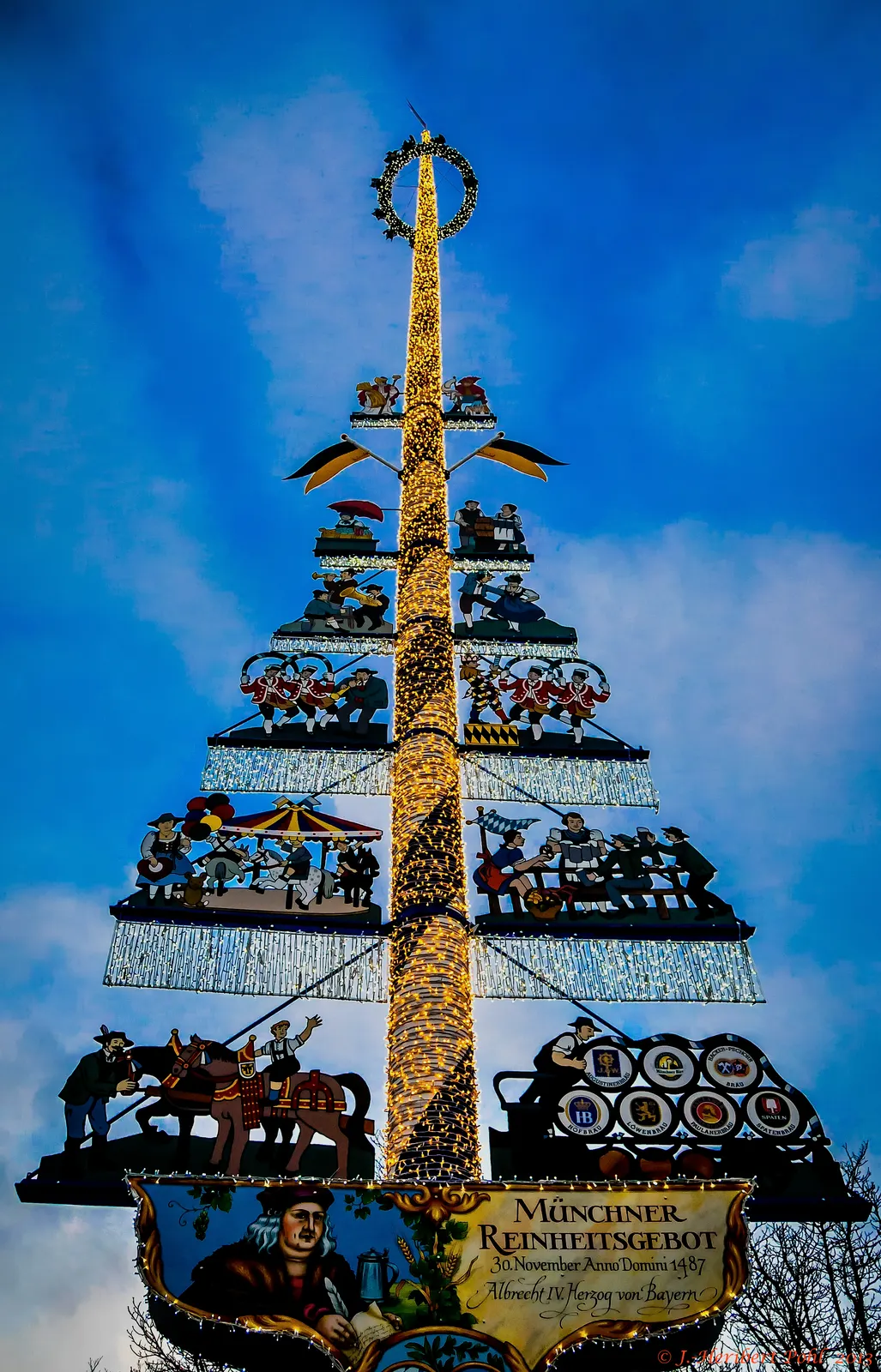
Photo: Heribert Pohl / Wikimedia Commons · CC BY-SA 2.0

- ✓The Viktualienmarkt is Munich's daily open-air food market, just off Marienplatz — a permanent maze of stalls selling produce, cheese, fish, meat, flowers and ready-to-eat snacks.
- ✓At its centre is a small beer garden under the blue-and-white maypole, where the tap rotates among the six Munich breweries; bring food from the stalls and buy only the beer at the self-service tables.
- ✓It's open daytime Monday to Saturday and closed on Sundays (like nearly all Munich shops); individual stalls keep their own hours, so go mid-morning to early afternoon for the fullest choice.
- ✓Use it as a lunch stop and a picnic-supply run rather than a single restaurant — graze across stalls, then carry a Brotzeit board out to a bench or the English Garden.
What the Viktualienmarkt is, and how to use it
The Viktualienmarkt — the name comes from the Latin for victuals, or provisions — is Munich's great daily food market, spread across a square just south of Marienplatz where it has fed the city since the early 19th century. It's not a one-off event or a tourist pop-up but a working market: roughly a hundred and forty permanent stalls and shops where Münchners actually do their shopping, selling fruit and vegetables, cheeses, sausages and cured meats, fish, honey, spices, herbs, flowers and a great deal more.
The right way to approach it as a visitor is to treat it as a grazing ground and a larder, not a restaurant. There's no single thing to order and no one counter to queue at; instead you wander, snack as you go, and assemble lunch from several stalls. You can eat extremely well here for very little, standing at a counter or perched at the market's tables — or you can buy the makings of a picnic and carry them off to a bench, the maypole garden, or the English Garden a short walk north.
Because it sits a minute from Marienplatz, the market is the obvious, characterful answer to 'where do we eat in the Old Town?' between sights. It beats the tourist restaurants ringing the square on both price and atmosphere, and it folds neatly into any Altstadt walk — climb the tower of Alter Peter, watch the Glockenspiel, then drop down to the market for lunch in fifteen minutes flat.
It helps to know the layout. The market is a loose grid of permanent stalls and little shops rather than a single hall, with the maypole and its small beer garden at the heart. Produce and flowers cluster toward the open square; the fishmongers, butchers, cheesemongers and the standing-counter snack stops are tucked among them; and the honey, spice and speciality shops line the edges. There's no need to plan a route — half the pleasure is wandering until something catches your eye — but knowing the shape means you won't miss the fish counters or the cheese stalls hidden a row back.
What to eat — the stalls and snacks to look for
The market's pleasure is in grazing, so go hungry and order small. Among the stalls and standing-counters you'll find Munich's classic snacks done well: a freshly griddled or grilled sausage in a roll, a bowl of soup at a cosy soup kitchen, fish — grilled, smoked or in a Fischsemmel (fish roll) — at the fishmongers, and warm pretzels at the bakeries. For a sit-down Bavarian classic, the small Weißwurst-and-beer stops here are an easy place to try the white sausage in its natural setting.
For a picnic or a Brotzeit board, the market is unbeatable. Buy cheese cut to order, Obatzda (the soft, spiced cheese spread), cold cuts and cured sausage, a radish (Radi) to slice, fruit, and bread, and you have the makings of the perfect beer-garden spread. Don't miss the honey and spice stalls for gifts and the famous Münchner specialities; the flower stalls that give the market its colour; and the seasonal produce that shifts through the year — white asparagus (Spargel) in late spring, chanterelles and stone fruit in summer, game and squash in autumn.
Two small pleasures are easy to overlook. The first is to eat standing up, the local way: many of the best bites here are designed to be had at a counter with a coffee or a beer, no table needed, in five unhurried minutes between sights. The second is to lean on the vendors — they're generous with a taste of a cheese or a slice of sausage, and asking what's good today, or what's just come into season, almost always turns up something better than whatever you walked in planning to buy.
- Sausages — a grilled or boiled Wurst in a roll from a counter; quick, cheap and very local.
- Fish — grilled or smoked fish and the Fischsemmel (fish roll) at the fishmongers.
- Soup — a bowl at one of the soup kitchens, ideal on a cold day.
- Brotzeit makings — cheese, Obatzda, cold cuts, cured sausage, a radi and bread for a picnic board.
- Pretzels & baked goods — warm Brezn and Bavarian breads from the bakeries.
- Sweet & seasonal — honey, jams and spices for gifts; Spargel in spring, berries and stone fruit in summer.
The maypole beer garden at the centre
At the heart of the market stands the Maibaum, the tall blue-and-white maypole painted in Bavarian colours and hung with little figures showing the local trades. Around its base is the market's own small beer garden — a cluster of self-service tables under the trees, where the tap famously rotates among the six Munich breweries through the year, so the beer on offer changes from season to season.
It works like any traditional Munich garden: at the self-service tables you may bring your own food and buy only the beer. This is the move — graze the stalls, build a board, then carry it to a bench with a Halbe or a Maß a minute from Marienplatz. It's one of the most central spots in the city to drink a Munich beer in the open air, and far more pleasant than any restaurant terrace on the square itself.

When to go, and the practical notes
Timing matters. The market runs in the daytime from Monday to Saturday and is closed on Sundays, in line with Germany's Sunday shop-closing rules — so don't build a Sunday lunch around it. Individual stalls keep their own hours and many wind down through the afternoon, so the fullest, freshest choice is mid-morning to early afternoon. Go too late in the day and you'll find shutters coming down; specific hours shift by stall and season, so treat times as a guide and verify if you're making a special trip.
A few small practicalities smooth the visit. Bring some cash, as not every stall takes cards; expect to pay a small deposit (Pfand) on a beer glass and get it back when you return it; and remember the market is most crowded at peak lunchtime, so just before or just after the rush is calmest. If you're shopping for a picnic to carry to the English Garden or the Isar, buy last so it stays fresh, and ask for cheese and meat to be cut and wrapped to order.
- Days — Monday to Saturday, daytime only; closed Sundays. Go mid-morning to early afternoon for the fullest choice.
- Hours vary — each stall sets its own; many wind down through the afternoon. Verify before a special trip.
- Cash — bring some; not every stall is card-friendly. Beer glasses carry a refundable deposit.
- Crowds — busiest at peak lunchtime; just before or after is calmer.
- Picnic tip — buy perishables last; have cheese and meat cut and wrapped to carry out to a park or the river.

At a glance
What it is — Munich's daily open-air food market just off Marienplatz; about 140 permanent stalls of produce, cheese, fish, meat, flowers and ready-to-eat snacks.
How to use it — graze across stalls for a fast lunch, or buy a Brotzeit to carry out; not a single restaurant but a larder and a snack run.
What to eat — sausages and fish rolls, soup, warm pretzels, and the makings of a picnic: cheese, Obatzda, cold cuts, radi and bread.
The beer garden — a small self-service garden under the maypole; bring food, buy only the beer; the tap rotates among the six breweries.
When to go — Monday to Saturday, daytime; closed Sundays; mid-morning to early afternoon is best — verify stall hours.
Good to know — bring cash, expect a glass deposit, buy perishables last, and avoid the peak-lunch crush for a calmer visit.

Viktualienmarkt, Munich
How to eat, shop and linger at Munich's open-air food market a minute from Marienplatz — the stalls, the beer garden under the maypole, and the unwritten rules that make it work.
Read guide
Where to Eat Near Marienplatz
Reliable lunches, snacks and dinners around Munich's busiest square — how to skip the tourist mark-ups by stepping a street back, and exactly where to go for a market lunch, a quick bite or a proper Bavarian meal.
Read guide
Bavarian Food to Try in Munich
What to order in Munich — Weißwurst, roast pork and pork knuckle, pretzels and dumplings, Obatzda and radi, the cakes and the beers — and the little rules that make each one make sense.
Read guideMore in Food & Drink
6
Augustiner-Keller, Munich
The beer garden, the cellar restaurant, reservations and what to order at the Augustiner-Keller near the Hauptbahnhof — the locals' choice for the city's most-loved beer.
Read guide
Best Beer Gardens in Munich
A seasonal guide to Munich's classic beer gardens — the chestnut-shaded benches, the bring-your-own rule, what to order, and which gardens suit families, dates or a quiet pint.
Read guide
Best Beer Halls in Munich
How to choose among Munich's great beer halls — the Hofbräuhaus, the Augustiner and Löwenbräu houses, Paulaner and more — compared by atmosphere, food, noise and first-time ease.
Read guide
Best Cocktail Bars in Munich
Where to drink well in a beer city — Munich's craft cocktail bars, hotel bars and late-night spots, picked by neighbourhood and vibe for date nights, a refined nightcap or somewhere open into the small hours.
Read guide
Best Coffee and Cafés in Munich
Where to find good coffee in Munich — specialty third-wave roasters, classic Kaffeehaus institutions and konditoreien — sorted by neighbourhood and by whether you want to work, linger romantically or grab a quick cup.
Read guide
Best Food Markets in Munich
Beyond the famous Viktualienmarkt — the neighbourhood and seasonal markets where Munich actually shops, for snacks, gifts, picnic supplies and a feel for the city's daily rhythm.
Read guide