
Westend, Munich
A characterful, food-forward district just west of the Theresienwiese — multicultural, increasingly hip, and one of the best-value central bases in Munich, especially for Oktoberfest.

Photo: Marko Lengyel / Unsplash

- ✓The Westend (officially Schwanthalerhöhe) is a compact, lively district pressed up against the western edge of the Theresienwiese — closest residential quarter to the Oktoberfest field after Ludwigsvorstadt.
- ✓It is one of Munich's most multicultural and food-forward areas, long working-class and now steadily gentrifying, with a strong, varied and good-value restaurant scene.
- ✓Rooms here generally undercut the Old Town while keeping you a short walk or one U-Bahn stop from the centre — a smart base for value-minded travellers.
- ✓Its proximity to the Theresienwiese makes it a prime, walkable choice for Oktoberfest, though rates rise sharply during the festival.
Where the Westend sits and how it feels
The Westend — its official district name is Schwanthalerhöhe, though everyone calls it the Westend — is a tightly packed quarter just west of the city centre, hard against the Theresienwiese where Oktoberfest is held. It grew in the 19th century as a working district of dense tenement blocks for factory and railway workers, and for a long time it had a rough, overlooked reputation. Over the past couple of decades that has changed: the Westend has become one of Munich's most talked-about up-and-coming areas, where the old multicultural fabric meets a wave of cafés, galleries and young residents priced out of pricier districts.
The result is a quarter with a genuine, slightly scruffy character that many visitors find more interesting than the polished centre. Turkish, Balkan, Italian and East Asian shops and restaurants sit alongside hip new coffee roasters and bars; the streets are lively and mixed; and there is a real sense of a neighbourhood in motion rather than a tourist set-piece. For travellers who want somewhere central, affordable and full of life — and who do not mind a bit of grit — it is one of the most rewarding places to base a Munich trip.
A food-forward, multicultural quarter
If there is one reason to seek out the Westend, it is the food. This is one of the best districts in Munich for eating cheaply, variedly and well, precisely because it is not built around tourists. The long migrant history of the area means an exceptional run of Turkish, Middle Eastern, Balkan, Italian and Asian kitchens — proper neighbourhood places where a meal costs a fraction of an Altstadt restaurant and tastes the better for it. Alongside them, the newer wave has brought specialty coffee, natural-wine bars, brunch spots and small, design-minded eateries, so you can swing from a kebab to a flat white to a low-key dinner without leaving the district.
This food-forward, casual character is the everyday pleasure of staying here. Mornings start in a real bakery rather than a hotel buffet; lunches are quick and cheap; evenings can be as simple or as stylish as you like. The Westend is not the place for grand Bavarian beer-hall theatre — for that you cross to the famous halls or the nearby Augustiner-Keller — but for genuine, affordable, everyday eating it is one of the strongest neighbourhoods in the city. Specific venues open and close fast in a gentrifying area, so wander and follow the crowds rather than chasing a single name.
It is worth dwelling on just how good the value is, because it is the Westend's defining everyday advantage. In a city where a central sit-down meal can cost a small fortune, here you can eat a generous, genuinely tasty plate for a fraction of the price simply because the restaurants serve a working, resident clientele who would not stand for tourist mark-ups. That changes the texture of a trip: you can afford to eat out every night, try cuisines you might not at home, and treat food as part of the adventure rather than a budget line to manage. For travellers watching their money — or simply tired of overpriced, underwhelming central restaurants — that alone can justify basing yourself here.

A practical, good-value base
The Westend's other great selling point is value. Because it has historically been a working district rather than a tourist one, room rates here generally come in below the Old Town for comparable quality, and the area has a good supply of mid-range and budget hotels as well as apartment rentals. You give up the immediate prettiness and the doorstep-monument convenience of the Altstadt, but you gain a more central price and a more genuine sense of place — a trade many travellers are glad to make.
Crucially, you do not give up much in the way of access. The Westend is barely west of the centre: Marienplatz and the Old Town are a brisk fifteen-to-twenty-minute walk or a couple of minutes by U-Bahn, the U4/U5 lines run through the district (Schwanthalerhöhe and Heimeranplatz among the stations), and the S-Bahn and Hauptbahnhof are close at hand for day trips and the airport line. For a base that is affordable, central and full of life, the Westend hits a sweet spot that the showier districts cannot match. As ever, confirm current prices and hotel details when you book.
- Value: room rates generally undercut the Altstadt for similar quality — verify current prices when booking.
- Access: Marienplatz is a 15–20 minute walk or a short U-Bahn ride; the U4/U5 serve the district.
- Connections: the Hauptbahnhof and S-Bahn are close by for day trips and the airport line.
- Trade-off: less polished and pretty than the Old Town, but more genuine and central-priced.
Oktoberfest on the doorstep
For anyone whose trip is built around Oktoberfest, the Westend deserves serious thought. The district sits directly on the western edge of the Theresienwiese, the great field where the festival is held, which means that from much of the Westend you can simply walk to the tents and — more importantly — walk home afterwards, avoiding the crush on the packed U-Bahn at closing time. That walkability is a genuine advantage during the busiest fortnight of the Munich year.
The catch is the same one that applies to every district near the meadow: room rates spike steeply for the festival, and the best-value rooms sell out months in advance. The Westend, being slightly less obvious than the immediate station area, can occasionally hold a little more value than the most heavily searched zones — but only if you book early. The festival runs roughly sixteen days from the third Saturday of September into early October, with dates that shift each year, so confirm them before you plan. Outside Oktoberfest the Theresienwiese on your doorstep is simply a large open space that also hosts the spring Frühlingsfest and other events.
- The Westend borders the Theresienwiese, so you can walk to the Oktoberfest tents and home again.
- Festival rates rise sharply and rooms sell out far ahead — book very early for the best value.
- Oktoberfest runs roughly 16 days, third Saturday of September into early October — verify exact dates.
- Off-season the meadow also hosts the Frühlingsfest and other events on the district's edge.
Green corners, culture and the district's past
The Westend is denser and more urban than the leafy western suburbs, but it is not without breathing space. On its southern flank, the Bavariapark — the green strip behind the colossal Bavaria statue and the Ruhmeshalle on the edge of the Theresienwiese — gives the district a proper park for a stroll or a picnic, with the bronze giantess looking down over the trees. It is an easy, free escape a few minutes from the busy streets, and a reminder that even Munich's grittier quarters keep their green corners. Smaller squares and pocket gardens are scattered through the residential blocks, where you will find the everyday life of the neighbourhood playing out.
Culturally, the Westend's transformation has brought galleries, studios and creative businesses into former industrial spaces — part of the same shift that turned old factory and brewery sites across this side of the city into design, media and event venues. The most famous local landmark of that industrial past is the former Augustiner brewery complex, whose old buildings near the district have found new uses, while the great Augustiner-Keller beer garden just to the north keeps the brewing heritage alive in the most enjoyable way. It is a district where you can read the city's working history in the architecture even as the bars and cafés around you point firmly to its future.
That layering — migrant communities, industrial bones, and a fresh creative energy — is exactly what gives the Westend its distinctive texture. It does not trade on grand monuments or Bavarian theatre; its appeal is the genuine, slightly raw character of a real Munich neighbourhood finding a second life. For the right traveller, that is far more memorable than another polished tourist street, and it is increasingly why visitors in the know choose to base themselves here.

Getting around and how to use the Westend
Moving around from the Westend is effortless. The U4 and U5 underground lines run through the district and connect it straight to the Hauptbahnhof, Karlsplatz and Marienplatz in a few minutes; trams and the S-Bahn fill in the rest; and a day ticket on the MVV makes hopping around cheap. On foot, the centre is close enough that many visitors simply walk in and out, and the Theresienwiese and the Augustiner-Keller beer garden are both within an easy stroll to the north and east.
The best way to use the Westend is as a comfortable, affordable home base from which to range across the city — sleep and eat among locals, walk or ride into the sights by day, and come back to a real neighbourhood in the evening. Spend at least one evening simply wandering its food streets without a plan; that unscripted, multicultural, slightly bohemian energy is the Westend at its best, and it is a side of Munich that the central districts rarely show.
Map pins
Map data © OpenStreetMap contributors · Tiles © OpenFreeMap
Is the Westend right for you?
The Westend rewards a particular kind of traveller and frustrates another, so it is worth being honest about the fit. It is a strong choice for the budget-conscious who still want to be central, for food-lovers who would rather eat among locals than in tourist restaurants, for younger and independent travellers drawn to a livelier, more bohemian quarter, and — crucially — for Oktoberfest visitors who want to walk to the tents. Its mix of value, variety and genuine neighbourhood energy is a deliberate alternative to the polished, pricier centre, and many repeat visitors to Munich come to prefer it.
It is a weaker pick for travellers who want classic Bavarian prettiness on the doorstep, for those who feel uneasy in a busy, gritty urban quarter, or for anyone whose idea of Munich is cobbled lanes and beer-hall folklore at every turn — that is the Altstadt's department, not the Westend's. The area is safe and lively rather than dangerous, but it is unmistakably urban and workaday, and visitors expecting a chocolate-box neighbourhood may be surprised. Knowing that going in is the difference between a base you appreciate and one that disappoints.
The clearest way to think about it: the Westend is where you stay to get an affordable, authentic, food-rich slice of real Munich a short walk from the sights. If that is what you are after, it punches well above its modest reputation. If you want storybook charm or quiet luxury, look to the central or western districts instead and visit the Westend for a meal. As always, hotels and restaurants change, so confirm specifics when you book.

At a glance
A quick planning reference. Confirm the volatile details — hotel prices and Oktoberfest dates — before you commit, as these change.
- What it is: a lively, multicultural, gentrifying district (officially Schwanthalerhöhe) just west of the Theresienwiese.
- Best for: value-minded travellers, food lovers, and Oktoberfest visitors who want to walk to the tents.
- Eating: one of Munich's best areas for cheap, varied, genuine food, plus a wave of newer cafés and bars.
- Access: Marienplatz 15–20 minutes on foot or a short U4/U5 ride; the Hauptbahnhof and S-Bahn close by.
- Value: generally cheaper than the Old Town for similar quality — verify current prices.
- Oktoberfest: borders the festival field; rates spike and sell out early — book well ahead and verify dates.

Budget Hotels in Munich
How to stay in Munich cheaply without ending up somewhere grim or remote — the best-value areas like Westend and the streets around the Hauptbahnhof, the hostel-versus-hotel calculation, and the transit trade-offs that decide whether a low price is actually a bargain.
Read guide
Oktoberfest Hotels in Munich
The honest guide to booking a hotel for Oktoberfest — why it's the city's priciest, most-booked fortnight, how early to reserve, the walkable areas near the Theresienwiese worth paying for, and the transit-friendly and out-of-town fallbacks that save real money without stranding you.
Read guide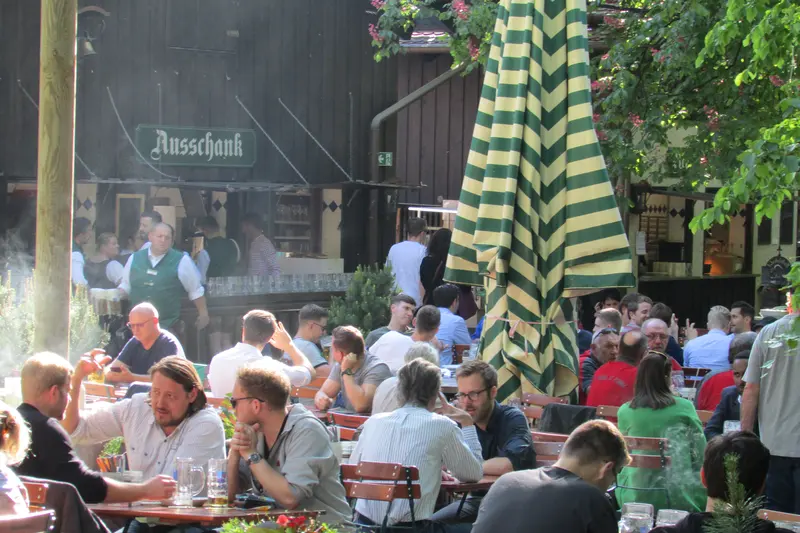
Augustiner-Keller, Munich
The beer garden, the cellar restaurant, reservations and what to order at the Augustiner-Keller near the Hauptbahnhof — the locals' choice for the city's most-loved beer.
Read guideMore in Neighborhoods
6
Altstadt Munich Guide
Munich's Old Town, the Altstadt, holds the city in miniature — Marienplatz and the Glockenspiel, the Frauenkirche, the Viktualienmarkt, the Residenz and the Hofbräuhaus, all inside a flat, walkable ring. Here's what to see, where to eat, where to stay, and how to sidestep the busiest hours.
Read guide
Around Olympiapark, Munich
The northern districts around Olympic Park, BMW Welt and the Olympic Village — a green, modern, family-friendly zone with strong transit links and easy reach of the Allianz Arena.
Read guide
Au, Munich
A local-feeling riverside quarter on the Isar's east bank — home to the thrice-yearly Auer Dult market, the Nockherberg and its strong-beer season, and quieter food and evenings away from the crowds.
Read guide
Best Area to Stay in Munich for a First Visit
A decisive, opinionated answer for first-timers — why the Altstadt (or its quiet fringe) is the right base for a first Munich trip, with Lehel, Maxvorstadt and Schwabing as the best alternatives and the station area as the value play.
Read guide
Best Hotels in Munich
How to pick the right Munich hotel — curated shortlists organised by area, by style, by budget and by season, with a clear method for choosing rather than a stale list of names, plus deeper guides to luxury and budget stays.
Read guide
Boutique Hotels in Munich
Where to find Munich's stylish smaller stays — the design-led boutiques of Maxvorstadt's museum quarter, the romantic Altstadt corners, and the bar-and-bistro hotels of the Glockenbachviertel — and how to pick the right one for your kind of trip.
Read guide