
Ludwigsvorstadt, Munich
The district wrapped around Munich's Hauptbahnhof and the Theresienwiese — the city's most connected, best-value base, the heart of Oktoberfest logistics, and what to know before you book.

Photo: Preston Foster / Unsplash

- ✓Ludwigsvorstadt wraps around the Hauptbahnhof, so it is the single best-connected place to stay in Munich — every S-Bahn, plus the airport line, leaves from your doorstep.
- ✓The Theresienwiese, the great open field where Oktoberfest is held, sits inside the district; if the festival is your reason for coming, this is the obvious base.
- ✓It is the value end of central Munich: more budget and mid-range hotels per street than anywhere else in the city, at the cost of polish.
- ✓The streets immediately north and west of the station are the grittiest in the centre — fine by day, less charming late at night — so choose your exact address with a little care.
Where Ludwigsvorstadt sits and why people stay here
Ludwigsvorstadt is the wedge of the inner city that fans out south and west from the Hauptbahnhof, Munich's vast central railway station, towards the Theresienwiese and the Sendlinger Tor. It is not a pretty postcard district in the way the Altstadt is — it grew in the 19th century as a dense, working quarter of tall apartment blocks, and much of it still reads that way — but it is one of the most useful places a visitor can base themselves. Almost everyone who comes to Munich passes through it, because almost everyone passes through the station.
The reason to book here is connection and value, plain and simple. You are a few minutes' walk from a station that funnels every S-Bahn line, the regional and long-distance trains, the U1/U2 and U4/U5 underground lines, and a dense knot of trams and buses. The hotels clustered around the station run cheaper than equivalent rooms inside the Altstadt ring, and there are simply more of them. If your trip is built around early trains, day trips, an Oktoberfest visit, or a tight budget, Ludwigsvorstadt earns its keep. If you have come for atmosphere and quiet evenings, you may prefer to sleep elsewhere and treat this district as the place you arrive and depart.
The Hauptbahnhof and unbeatable connections
The whole case for Ludwigsvorstadt comes down to the Hauptbahnhof. From here the S1 and S8 both run out to Munich Airport in roughly forty to forty-five minutes, so you can step off a plane and be checked in without a single change — a genuine advantage with luggage or after a long flight. The station is also the launchpad for almost every day trip: trains south to the Alps and Garmisch, west to the lakes, the regional service towards Neuschwanstein, and the fast lines to Salzburg and Nuremberg all originate or stop here.
Inside the centre, the station ties straight into the rest of the network. The main east–west S-Bahn trunk runs underground beneath it, putting Marienplatz two stops and a few minutes away; the U-Bahn and a web of trams fill in everywhere else. Note that the Hauptbahnhof has been through a long, phased reconstruction, so the layout, entrances and some platforms can differ from older maps and signage — allow a few extra minutes to find your platform the first time, and verify your departure details on the day.
- Airport: the S1 and S8 reach Munich Airport in about 40–45 minutes, direct from the Hauptbahnhof (verify times).
- Old Town: the S-Bahn trunk puts Marienplatz two stops away; it is also a 12–15 minute walk via Karlsplatz.
- Day trips: trains to the Alps, the lakes, Neuschwanstein, Salzburg and beyond start or stop here.
- Within the city: U1/U2 and U4/U5, plus trams and buses, all serve the station forecourt.
- Note: the station is under long-term reconstruction, so layouts and platforms can change — verify on the day.

The Theresienwiese and Oktoberfest at your door
The other defining feature of Ludwigsvorstadt is the Theresienwiese — the "Theresa's Meadow" — a huge open field on the district's southern edge that lies empty most of the year and erupts into the world's largest folk festival each autumn. Oktoberfest runs for around sixteen days, beginning on the third Saturday of September and ending in the first days of October; the dates shift each year, so confirm them before you book. For those sixteen days the meadow fills with the great beer tents, the funfair rides, and millions of visitors, and the surrounding streets of Ludwigsvorstadt become the festival's natural lodging zone.
Staying here during the Wiesn means you can walk home — a real benefit when the U-Bahn is packed and the city is at its busiest. The trade-offs are equally real: room rates in this district spike dramatically for the festival fortnight and book out far in advance, and the nightly noise and crowds are part of the deal. Outside Oktoberfest the Theresienwiese still earns visits — it hosts the Frühlingsfest spring festival, the Tollwood winter market and other events, and the rest of the year it is simply a windswept open space crowned by the colossal Bavaria statue and her hall of fame, the Ruhmeshalle, which you can climb for a view back over the city.
- Oktoberfest runs roughly 16 days, from the third Saturday of September into early October — verify the exact dates each year.
- Ludwigsvorstadt is the closest residential district to the Theresienwiese, so you can often walk home from the tents.
- Festival-fortnight room rates rise sharply and sell out months ahead; book very early or stay further out.
- Off-season the meadow hosts the Frühlingsfest and Tollwood, and the Bavaria statue and Ruhmeshalle are worth a look.
Booking smart: which streets, and the honest trade-offs
Ludwigsvorstadt is not one mood but several. The blocks immediately north and west of the station — the area sometimes lumped together with the Bahnhofsviertel — are the rough edge of central Munich: a busy, multicultural quarter of cheap hotels, late-night shops, kebab and Asian restaurants and a transient feel that can be lively by day and a little bleak after dark. It is rarely dangerous in any serious sense, but solo travellers and light sleepers may want to read recent reviews of a specific hotel's street before committing.
Move a few streets south and the character softens considerably. The stretch towards the Sendlinger Tor and the part of the district sometimes called the Glockenbach edge is calmer, leafier and more residential, while still keeping you close to the station and a short walk from the Old Town. As a rule of thumb, the further you book from the immediate station forecourt, the more pleasant the evenings — without losing the connectivity that brought you here. Hotel quality, names and prices change constantly, so treat any specific recommendation as something to verify against current reviews rather than a fixed fact.
- Closest to the station: cheapest and most connected, but the grittiest and busiest after dark.
- Towards Sendlinger Tor and the south of the district: calmer, more residential, still very central.
- Light sleepers and solo travellers: read recent reviews of the exact street before booking.
- Value reality: rooms here undercut the Altstadt, which is much of the point — verify current prices.

Eating, drinking and the everyday district
For all its reputation as a transit zone, Ludwigsvorstadt eats well in an unpretentious way. The area around the station is one of the most diverse in the city for food — Turkish, Middle Eastern, Balkan, East African and a strong run of East and Southeast Asian restaurants sit cheek by jowl, and this is where many Münchners come for a cheap, genuine meal that is anything but the Bavarian cliché. If you want a break from pork knuckle and dumplings, you will find it here more readily than almost anywhere else in the centre.
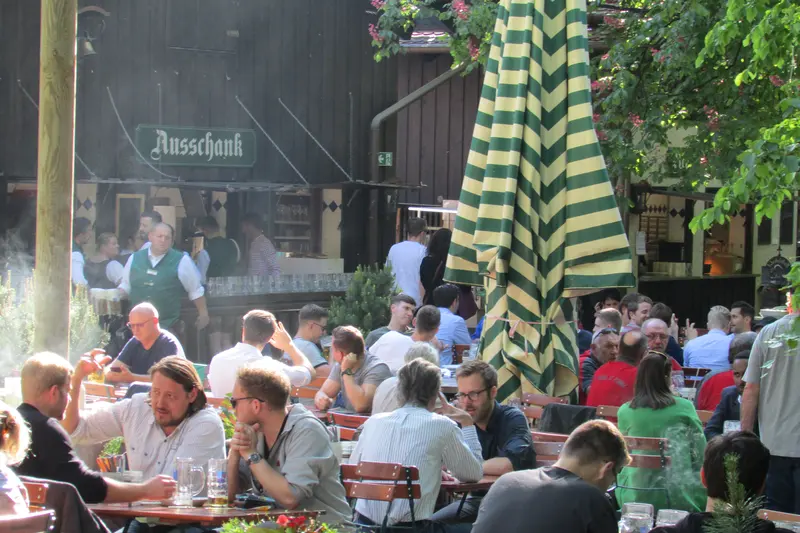
For the Bavarian side of things, the district delivers too: the Augustiner-Keller, one of the city's grandest and most beloved beer gardens, sits at the western edge near the Hackerbrücke, pouring its beer from wooden barrels under old chestnut trees. It is an easy walk from most station-side hotels and makes a perfect first or last evening in the city. Beyond food, this is a working part of Munich — supermarkets, pharmacies, late shops and everyday services are all to hand, which is exactly what you want when you are travelling and need to restock or fix something quickly.

The clinic quarter and the district's two faces
It surprises many visitors to learn that a large part of Ludwigsvorstadt is given over not to hotels but to medicine. The southern and central stretch of the district, around Goethestraße and Pettenkoferstraße, is Munich's historic Klinikviertel — a dense cluster of university hospitals, clinics and medical institutes that has been the heart of the city's healthcare and medical research for well over a century. The streets here are calmer and more dignified than the station forecourt, lined with handsome 19th-century buildings, and the presence of the clinics gives this part of the district a quiet, purposeful, distinctly un-touristy character.
This split personality is the key to understanding Ludwigsvorstadt. The northern edge, by the tracks, is the busy, rough-and-ready transit and arrival zone; the southern reaches towards Sendlinger Tor and the clinic quarter are settled, residential and noticeably more pleasant to walk in the evening. The same district name covers both, which is why generic advice about "staying near the Hauptbahnhof" can be misleading — the experience varies enormously block by block. Reading the exact street, not just the district, is what separates a savvy booking from a disappointing one.
The wider arrival quarter has also been slowly changing. Like station districts in many European cities, the area around Munich's Hauptbahnhof has long carried a slightly seedy reputation, but it is also genuinely diverse, well policed and busy at most hours, and ongoing redevelopment — including the long station rebuild — is gradually reshaping it. None of this should put off a sensible traveller; it simply means treating the immediate station blocks as a practical base to sleep and connect from, rather than a place you come to linger for atmosphere.

Getting around and combining it
From Ludwigsvorstadt almost everything is either walkable or one short ride away. The Old Town is a twelve-to-fifteen-minute stroll east via Karlsplatz (Stachus) and the pedestrianised Kaufingerstraße, so you can reach Marienplatz, the Frauenkirche and the Viktualienmarkt on foot. For everywhere else, the station hands you the entire network: a day ticket on the MVV usually beats single fares if you plan to move around, and it covers the U-Bahn, S-Bahn, trams and buses you will use to reach the parks, museums and palaces.
Because it is the city's transport heart, Ludwigsvorstadt slots naturally into the start and end of any Munich trip — arrive, drop your bags, and you are minutes from your first day trip or your flight home. If you are weighing it against other bases, the short version is: choose it for connection, value and Oktoberfest, and look to the Altstadt, Maxvorstadt or Schwabing if atmosphere and quiet evenings matter more.
Map pins
Map data © OpenStreetMap contributors · Tiles © OpenFreeMap
Is Ludwigsvorstadt right for you?
Ludwigsvorstadt is the most purely practical of Munich's central districts, and whether it suits you comes down to what you weigh most. It is the obvious base for travellers on a budget, for anyone with early trains or an early flight to catch, for day-trippers who will be in and out of the Hauptbahnhof daily, and for Oktoberfest visitors who want to be able to walk home from the Theresienwiese. If connection and value top your list, nowhere in the centre beats it, and the slight roughness around the station is a fair price for the convenience and the savings.
It is a weaker fit for travellers who have come chiefly for atmosphere — for honeymooners, for those who want to step out of the hotel into a beautiful, quiet quarter, or for light sleepers who will be unsettled by the late-night bustle of an arrival district. For them, the calmer, prettier streets of the Altstadt, Maxvorstadt, Schwabing or Neuhausen are worth the higher price or the short commute, with Ludwigsvorstadt visited only as the place they catch their trains. The good news is that even those travellers will pass through happily, because the district is so central and so well connected.
The simplest rule is to be deliberate about your exact street. Book towards the calmer southern reaches near Sendlinger Tor and the clinic quarter, read recent reviews of the specific hotel, and you get the connectivity and value without much of the grit. Treat the district as a smart logistical base rather than a sightseeing destination in itself, and it does its job exceptionally well.
At a glance
A quick planning reference. Confirm the volatile details — hotel prices, Oktoberfest dates and station layout — before you commit, as these change.
- What it is: the district around the Hauptbahnhof and Theresienwiese — Munich's most connected, best-value central base.
- Best for: tight budgets, day-trippers, early-train and early-flight travellers, and Oktoberfest visitors.
- Connections: every S-Bahn and the airport line (S1/S8, ~40–45 min) from the station; Marienplatz 2 stops away.
- The catch: the immediate station blocks are the grittiest in the centre — book a little south for calmer evenings.
- Oktoberfest: the Theresienwiese is in the district; rates spike and sell out far ahead — verify dates and prices.
- Don't miss: the Augustiner-Keller beer garden and the Bavaria statue and Ruhmeshalle on the meadow's edge.

Where to Stay for Oktoberfest
An area-by-area guide to choosing a base for Oktoberfest — the walkable districts that ring the Theresienwiese, the transit-friendly inner neighbourhoods a few stops out, the out-of-town value play, and the safer booking windows that decide whether you get a good room at all.
Read guide
Oktoberfest Munich: The Complete First-Timer's Guide to the Wiesn
Everything you need for Oktoberfest — when it runs and where, how the fourteen big tents work, whether you need a reservation, what it costs, what to eat and drink, how to get there and where to stay, the etiquette and the traditions, plus a sane first-timer plan. The world's biggest folk festival, explained without the hype.
Read guide
Munich Hauptbahnhof Guide
How to use München Hauptbahnhof with confidence — the layout across main-line, S-Bahn and U-Bahn levels, finding your platform, left luggage and lockers, food and services, the airport line, and how the station turns Munich into a brilliant day-trip base.
Read guideMore in Neighborhoods
6
Altstadt Munich Guide
Munich's Old Town, the Altstadt, holds the city in miniature — Marienplatz and the Glockenspiel, the Frauenkirche, the Viktualienmarkt, the Residenz and the Hofbräuhaus, all inside a flat, walkable ring. Here's what to see, where to eat, where to stay, and how to sidestep the busiest hours.
Read guide
Around Olympiapark, Munich
The northern districts around Olympic Park, BMW Welt and the Olympic Village — a green, modern, family-friendly zone with strong transit links and easy reach of the Allianz Arena.
Read guide
Au, Munich
A local-feeling riverside quarter on the Isar's east bank — home to the thrice-yearly Auer Dult market, the Nockherberg and its strong-beer season, and quieter food and evenings away from the crowds.
Read guide
Best Area to Stay in Munich for a First Visit
A decisive, opinionated answer for first-timers — why the Altstadt (or its quiet fringe) is the right base for a first Munich trip, with Lehel, Maxvorstadt and Schwabing as the best alternatives and the station area as the value play.
Read guide
Best Hotels in Munich
How to pick the right Munich hotel — curated shortlists organised by area, by style, by budget and by season, with a clear method for choosing rather than a stale list of names, plus deeper guides to luxury and budget stays.
Read guide
Boutique Hotels in Munich
Where to find Munich's stylish smaller stays — the design-led boutiques of Maxvorstadt's museum quarter, the romantic Altstadt corners, and the bar-and-bistro hotels of the Glockenbachviertel — and how to pick the right one for your kind of trip.
Read guide