
Bike Rental in Munich
How to rent a bike in Munich — rental shops versus the city's public bike-share — where to ride along the Isar and through the English Garden, the lane and traffic rules that keep you safe, and the loveliest easy routes.

Photo: Yves Cedric Schulze / Unsplash

- ✓Munich is one of Europe's most cycle-friendly big cities: flat, laced with marked bike lanes, and built for two wheels — a bike is a genuine way to see it.
- ✓Two ways to rent: a rental shop for a day or several (often with locks, route tips and e-bikes), or the city's public bike-share for short, app-unlocked hops.
- ✓The best riding is along the Isar and through the English Garden — green, mostly car-free, and beautiful end to end.
- ✓Respect the lanes: ride in the marked cycle track (not the pavement or the road), signal your turns, and use lights after dark — locals and police take it seriously.
- ✓Operators, prices and bike-share station details change, so verify the current options; the routes and the rules of the road don't.
Why Munich is a brilliant city to cycle
Munich rides like a dream. The city is flat, generously laced with dedicated cycle lanes, and culturally devoted to the bicycle — locals of every age cycle to work, to the beer garden, to the river — so as a visitor you slot into an existing, well-built network rather than fighting traffic for space. A bike covers ground a walker can't: you can string the English Garden, the Isar banks, a palace park and a riverside beer garden into a single golden afternoon, stopping wherever you like. For the right kind of day, it's the most joyful way to see the place.
Two honest caveats. The bike network is excellent but it has its own etiquette and rules, which you need to respect to stay safe and welcome (more below). And a bike isn't the tool for everything — the Altstadt's busiest pedestrian streets are for walking, and some sights are better reached by tram or on foot. Used for the parks, the river and the leafy boulevards, though, a rented bike is one of the best decisions you can make in summer Munich.
Rental shops versus the public bike-share
You've got two clean ways to get a bike. A traditional rental shop is best when you want a bike for a half-day, a full day or several days of proper exploring: you choose your bike (city bikes, often e-bikes and sometimes kids' bikes and trailers), usually get a lock and a quick safety briefing, and many shops will point you to the best routes or run guided tours. You pay per period and return the bike to the shop. This is the route for a planned day of riding the Isar or the parks, and the easiest if you want advice or an e-bike for longer distances.
The alternative is Munich's public bike-share, run by the city's transport operator, which lets you unlock a shared bike with an app for short, point-to-point trips and leave it at the end. It's ideal for spontaneous, one-way hops — riding from a sight to a beer garden, say — rather than a long day in the saddle, and it's woven into the same transit ecosystem you're already using. Both options change over time — operators, the bike-share's stations and rules, and all the prices move around — so check the current shop offerings or the live bike-share app before you commit, and confirm what's included (lock, helmet, insurance).
- Rental shop — best for a half-day to several days; city bikes, e-bikes, locks, route tips, guided tours.
- Public bike-share — app-unlocked shared bikes for short, one-way hops, tied into the city's transit operator.
- Shops suit planned riding days; bike-share suits spontaneous point-to-point trips.
- Operators, stations and prices change — check the live app or shop, and what's included (lock/helmet).

The best places to ride
Two routes stand above the rest, and both are mostly green and car-free. The Isar river paths are the city's great cycling artery: a near-continuous ribbon of cycle track runs along both banks, threading gravel beaches, weirs and willows, and you can follow it south out of the city toward the foothills or north to the river's wilder reaches. The English Garden is the other classic — one of the largest city parks in the world, with broad paths past the Eisbach surfers, the Chinese Tower beer garden and the Monopteros, all rideable at an easy pace. Linking the two makes a perfect, gentle half-day.
Beyond those, the flat, tree-lined boulevards and the route out to Schloss Nymphenburg and its park reward a ride, and quieter residential districts are pleasant to potter through. Keep off the busiest Altstadt pedestrian zones, where cycling is restricted or unwelcome, and out of the dedicated jogging-and-stroller flow where signs ask you to. Plan a loose loop — river out, park back, a beer garden in the middle — rather than a fixed dash, and let the city's green do the rest.
- The Isar paths — near-continuous riverside cycle track on both banks, city to foothills.
- The English Garden — vast, green and rideable, past the Eisbach wave and the Chinese Tower.
- The boulevards out to Nymphenburg Palace and its park make a fine longer ride.
- Avoid the busy Altstadt pedestrian zones, where cycling is restricted.
Safety and the rules of the road
Cycling in Munich is safe and easy precisely because everyone follows the same conventions, so as a visitor you should too. The cardinal rule: ride where you're meant to. Munich has extensive marked cycle lanes — sometimes a coloured strip on the road, often a separate track running alongside the pavement — and you ride in those, not on the general pavement (where cycling is usually forbidden) and not weaving through pedestrians. Obey traffic lights, including any dedicated cycle signals; signal your turns with an outstretched arm; and don't ride against the flow on one-way cycle tracks.
A few more essentials. Lights are required after dark — a working front and rear light is the law, so make sure your rental has them if you'll ride at dusk. Helmets aren't legally mandatory for adults in Germany but are sensible and recommended, especially on busy roads; ask the shop if one's available. Don't drink and ride — German drink-driving limits apply to cyclists too, and they're enforced. Lock your bike to something fixed whenever you leave it, since bike theft is the main risk, and keep an eye out for pedestrians stepping into lanes, tram tracks (cross them at an angle so your wheel doesn't catch), and opening car doors. Ride predictably and you'll find the city remarkably welcoming.
- Ride in the marked cycle lanes — not the pavement (usually banned) or against the flow.
- Obey traffic and cycle signals; signal turns with your arm.
- Lights are legally required after dark; helmets are recommended though not mandatory for adults.
- Don't drink and ride — limits apply to cyclists; always lock the bike to something fixed.
- Watch for tram tracks (cross at an angle), car doors and pedestrians in the lane.
Practical tips before you set off
A little preparation makes the ride better. Munich's best cycling weather is roughly spring through early autumn; summer is glorious but can bring sudden afternoon showers, so pack a light layer and check the forecast. Bring or rent a lock and use it religiously. Note that bikes can usually be taken on the U-Bahn and S-Bahn outside peak commuter hours with the right ticket, which lets you ride out and train back if you tire — handy on a longer Isar run — but the rules and any bike supplement change, so check the current conditions before you wheel a bike onto a platform.
Set up a maps app with a cycling layer, downloaded offline, so you can follow the river and park paths without fishing for a signal; many of the nicest routes are well signposted on the ground too. Wear something visible if you'll ride at dusk, carry water and a snack for the longer green stretches (or plan a beer-garden stop, which is the civilised option), and keep your valuables secure in a bag rather than an open basket. None of this is onerous — Munich makes cycling about as friendly as a city can — but the small preparations turn a good ride into an effortless one.
- Best season is roughly spring to early autumn; pack a light layer for summer showers.
- Always lock the bike; bring or rent a good lock.
- Bikes are usually allowed on the U-/S-Bahn off-peak with the right ticket — verify current rules.
- Use an offline cycling map; routes along the Isar and parks are well signed.

At a glance
Why ride — Munich is flat, lane-rich and cycle-mad; a bike is a real way to see the parks and the river.
Renting — a shop for a planned day (bikes, e-bikes, locks, tours) or the city bike-share for short app-unlocked hops.
Where — the Isar river paths and the English Garden, then the boulevards out to Nymphenburg; skip the busy Altstadt.
Rules — ride in the marked lanes, obey signals, lights after dark, helmets recommended, don't drink and ride, lock up.
Verify — operators, prices, bike-share stations and bike-on-train rules all change; check current details before you ride.

The Isar River, Munich
Munich's wild green river — where to walk and cycle, the gravel beaches and the Flaucher, the swim-season caveats, and the loveliest sunset stops along the water.
Read guide
The English Garden, Munich
How to walk Munich's vast central park — the Eisbach surf wave, the Monopteros viewpoint, the Chinese Tower beer garden, the lawns, the streams and the long route north to the Kleinhesseloher See.
Read guide
Getting Around Munich
The full picture of moving around Munich — why you'll walk more than you expect, when to take the U-Bahn or a tram, how the city's flat streets reward a bike, when a taxi or rideshare earns its keep, and the firm case for leaving the car at home.
Read guideMore in Travel Tips
6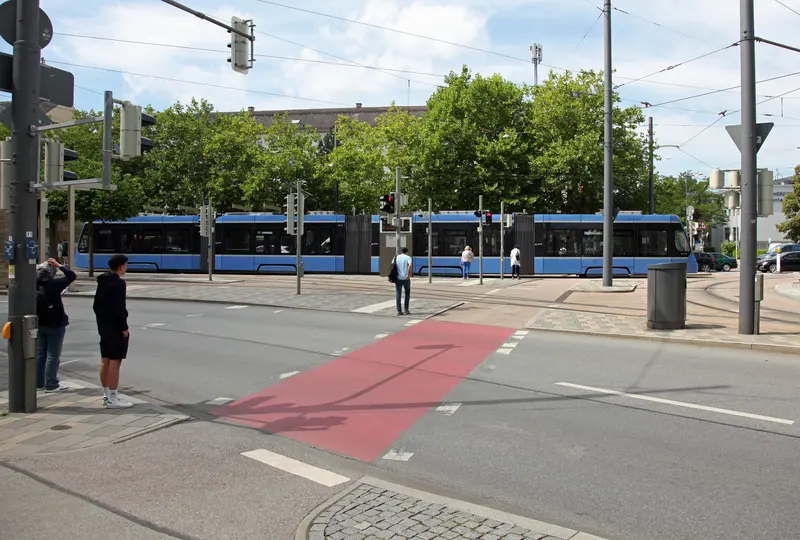
Accessible Munich: A Step-Free Travel Guide
A realistic, planning-led guide to accessible Munich — step-free transport on the U-/S-Bahn and trams, museums and palaces with lift access, the cobbles and surfaces of the Old Town to plan around, and how to reach the city from the airport without stairs.
Read guide
Best Time to Visit Munich
When to come to Munich, season by season and month by month — the tradeoffs of weather, crowds, prices and what's on, from beer-garden summers to the snow-lit Christmas markets.
Read guide
Driving & Parking in Munich
Whether you need a car in Munich at all, the low-emission Umweltzone rule, parking zones, garages and Park & Ride, and the smarter strategy: ditch the car in the city and rent only for the day trip.
Read guide
Is Munich Safe? A Visitor's Safety Guide
An honest, common-sense read on safety in Munich — how safe the city really is, the few situations to keep your wits about (the station area, festival crowds, pickpockets, cycling), the scams to ignore and the emergency numbers worth memorising.
Read guide
Money & Tipping in Munich
How money works in Munich — cards versus cash, ATMs and fees, how much to tip and the correct way to do it, receipts, and the small habits that keep paying friction-free.
Read guide
Munich Airport to the City Centre
How to get from Munich Airport to the city centre — the S-Bahn lines and tickets, the express bus, taxis and private transfers, and a simple decision guide for which to take.
Read guide