
Berchtesgaden and Eagle's Nest
How to reach the Eagle's Nest and the Berchtesgaden valley from Munich — the seasonal road, the Königssee, the dark history, and whether to go independently or by guided tour.

Photo: Mario Dobelmann / Unsplash

- ✓Berchtesgaden is Bavaria's deep south-east corner — about 2–2.5 hours from Munich by train (via Freilassing) — a full, long Alpine day rather than a half-day jaunt.
- ✓The Eagle's Nest (Kehlsteinhaus) is strictly seasonal: its access road and special buses run only roughly mid-May to late October, weather permitting — verify the current opening dates before you plan around it.
- ✓You cannot drive up to the Eagle's Nest yourself; access is by the dedicated Kehlsteinhaus shuttle bus and a final brass elevator (or a steep walk) only.
- ✓The valley pairs the Eagle's Nest with the fjord-like Königssee and the sobering Dokumentation Obersalzberg — a day that is scenic and historically heavy in equal measure.
What Berchtesgaden actually is — and why it's a long day
Berchtesgaden sits at the very bottom-right of Germany, a knob of Bavarian Alps almost entirely surrounded by Austria, gathered around the Watzmann — the country's third-highest peak — and the impossibly green Königssee. It is one of the most beautiful corners of the Alps within reach of Munich, and one of the most layered: a landscape of postcard mountains carrying a dark twentieth-century history, because this is where the Nazi leadership built its mountain retreat, the Obersalzberg, and the cliff-top eyrie known to the world as the Eagle's Nest.
Be clear-eyed about the distance. Berchtesgaden is roughly two to two and a half hours from Munich by public transport, usually with a change at Freilassing, which makes this a committed full-day trip — earlier start, later return — rather than an easy half-day. Add the in-valley travel between the station, the Eagle's Nest and the Königssee, and you have a day that needs planning. It rewards the effort generously, but it is not a spur-of-the-moment outing the way Salzburg, just over the hill, can be.
The other thing to understand before you go is that the Eagle's Nest — the single sight most people come for — is fiercely seasonal and weather-dependent. The mountain road and the special buses that are the only way up operate for roughly half the year, usually mid-May into late October, and even within the season a low cloud day can shut the summit. If the Eagle's Nest is the whole point of your trip, check that it's open before you buy a train ticket, and have a backup plan for the valley below.
Getting there from Munich
The independent route is a train from Munich's Hauptbahnhof toward Berchtesgaden, typically changing at Freilassing onto the branch line that climbs into the valley. The regional legs are covered by Bavaria's flat-rate day pass, the Bayern-Ticket, which makes the journey good value for two or more — though, as with any regional ticket, you're on the slower trains and bound by its time conditions (generally valid from 09:00 on weekdays). Confirm the day's connections and the ticket terms before you go (please verify), as the change at Freilassing makes the timing matter more than on a direct line.
From Berchtesgaden station, the sights are spread around the valley and reached by local RVO buses: one service heads up the Obersalzberg toward the Eagle's Nest connection, another runs out to the Königssee jetty at Schönau. These local buses are the connective tissue of a Berchtesgaden day, and they don't run as frequently as a city network, so it pays to note the return times. Because the moving parts — train change, valley buses, the Eagle's Nest shuttle, the Königssee boat — all have to mesh, this is the day trip where a guided tour earns its keep most clearly.
That tour option is worth a serious look here. Full-day coach tours from Munich to Berchtesgaden, the Eagle's Nest and the Königssee handle every transfer, include the Eagle's Nest bus ticket and the boat, and add a guide's commentary on the heavy history — turning a logistically fiddly day into a sit-back-and-watch one. The trade-off is the usual one: less freedom, a fixed schedule and a group pace, against the certainty of getting everything connected. For first-timers, or anyone short on time and patience for branch-line timetables, it's often the smarter choice.
- Independent: train from München Hbf, change at Freilassing, ~2–2.5 hrs (verify connections).
- Tickets: regional legs covered by the Bayern-Ticket — good value for 2+, slower trains only.
- In the valley: local RVO buses link the station, the Obersalzberg/Eagle's Nest and the Königssee.
- Easiest overall: a guided full-day coach tour from Munich that bundles bus, boat and history.
- Note return bus and train times early — the connections are tighter than on a direct line.

The Eagle's Nest (Kehlsteinhaus) — how it works
The Eagle's Nest is the building called the Kehlsteinhaus, a stone lodge built in the 1930s on a rock spur at over 1,800 metres, presented to Hitler as a fiftieth-birthday gift by the Party. Reaching it is a deliberately staged piece of theatre. From the Obersalzberg you transfer onto a fleet of special buses that grind up a vertiginous private mountain road — closed to all private vehicles — to a tunnel cut into the rock. There you walk through the tunnel to a polished brass elevator, the original 1930s lift, that rises the final stretch inside the mountain to the house itself. There is no other way up by vehicle; the only alternative is a steep hiking trail.
The house today is run as a mountain restaurant and viewpoint, and the draw is overwhelmingly the setting rather than the rooms: a 360-degree panorama over the Berchtesgaden Alps, down to the valley and across into Austria, with the marble fireplace (a gift from Mussolini) one of the few interior remnants. Crucially, the Eagle's Nest is not the main historical museum — for the documented history you want the Dokumentation Obersalzberg below. Treat the Kehlsteinhaus as the summit spectacle and the documentation centre as the substance.
Two operational points decide your day. First, the season: the road and buses run only for roughly half the year (about mid-May to late October), and a cloudy day can close or whiteout the summit — so verify the opening dates and, ideally, the morning's weather. Second, the buses are timed and ticketed, with a return slot allocated when you go up; you can't dawdle indefinitely at the top. Plan the Eagle's Nest as a fixed-window experience, and build the rest of the day around the slot you're given.
- Only way up: the dedicated Kehlstein shuttle bus from the Obersalzberg, then a brass elevator (or a steep walk).
- No private cars on the mountain road — period.
- Season: roughly mid-May to late October, weather permitting — verify the current dates.
- The draw is the panorama; the documented history lives at the Dokumentation Obersalzberg below.
- Buses are timed with an allocated return — you can't linger indefinitely at the summit.
A note on tickets, timing and the bus chain
Because so much of the Eagle's Nest day runs on fixed schedules, it pays to understand how the tickets stack up before you arrive. From Berchtesgaden you first take a regular RVO bus up to the Obersalzberg; only there do you transfer to the special Kehlstein bus that climbs the private road, and that final leg is a separate, timed ticket — you're given a return time when you board, which caps how long you spend at the summit. The documentation centre below is ticketed separately again. Pricing and timetables for each of these change seasonally, so confirm the current details on the official sites rather than relying on figures that may have moved (please verify).
The practical upshot is that an independent Eagle's Nest day is a small relay of connections — Munich train, Freilassing change, valley bus, Kehlstein bus, and the same again in reverse — and the margins between them are what you're managing all day. Build in buffer time at each handover, especially the train change, and front-load the day: aim to be on an early Kehlstein bus so a delayed connection later doesn't strand you. If that sounds like a lot to choreograph for one summit, it's a fair reason to let a guided tour do the choreographing for you, which is precisely why so many visitors here do.
The history you should not skip
It would be a kind of evasion to come to the Obersalzberg only for the view. This mountainside was the Nazi regime's second seat of power — a fortified complex of leaders' residences, barracks and bunkers, where much of the Third Reich's business was done away from Berlin. Most of it was bombed and later demolished, but the place and its meaning remain, and the way to engage with it honestly is the Dokumentation Obersalzberg, a sober, well-made documentation centre that lays out the history of the site and the regime, including access to a surviving section of the underground bunker system.
Hold the two things together as you go. The Eagle's Nest is genuinely beautiful, and the Königssee below it is one of the loveliest lakes in the Alps — but the same slopes were chosen by the regime precisely for their grandeur, and to walk them without acknowledging that is to miss the point of being there. The documentation centre is what turns a scenic day into a meaningful one. If your time in the valley is tight, prioritise it over a long lunch at the summit; the view will still be there, and the understanding is the thing you can't get anywhere else.
Adding the Königssee — the day's other half
If the Eagle's Nest is the summit, the Königssee is the valley's quiet masterpiece, and the two together make the classic Berchtesgaden day. The Königssee is a long, narrow, fjord-like lake of astonishing clarity, hemmed by sheer cliffs and reachable only on foot or by the fleet of quiet electric boats that have plied it for generations. The boats glide deep into the mountains to the famous red-onion-domed pilgrimage chapel of St. Bartholomä, pausing partway so a crewman can play a flugelhorn toward the cliffs and let the echo answer — a small, perfect bit of Alpine theatre.
Fitting both the Eagle's Nest and a Königssee boat into one day from Munich is ambitious but doable, especially on a guided tour built to do exactly that. Independently it's tighter: you're juggling the Eagle's Nest bus slot, the valley buses and the boat timetable, and a slow connection at either end can unravel the plan. A common compromise is to give the Eagle's Nest the morning and a short Königssee boat the afternoon, or simply to choose one as the day's centrepiece. For the full lake story — boat timing, transit realities and whether it's worth a day of its own — see the dedicated guide.
What else the valley holds — and a rainy-day plan
If the Eagle's Nest is closed for the season, or the weather hides the heights, the Berchtesgaden valley still has plenty to fill a day — which is reassuring on a trip this long. The best-known indoor alternative is the Berchtesgaden salt mine (Salzbergwerk), where the region's centuries-old salt-mining heritage is turned into a visitor experience: you don miners' overalls, ride a small train into the mountain, slide down wooden miners' chutes and cross an underground brine lake. It's weatherproof, family-friendly and genuinely fun, and it tells the story of the wealth that made this remote valley matter long before the twentieth century.
The market town of Berchtesgaden itself is worth a wander too, with a Wittelsbach royal palace (Königliches Schloss) at its heart, painted houses around the marketplace and a backdrop of mountains on every side. And for the energetic, the area is laced with hikes and cable cars — the Jenner cable car above the Königssee lifts you to a high viewpoint over the lake and the surrounding peaks, weather permitting. None of these need replace the headline sights; they're the insurance that turns a long, weather-dependent journey into a day that holds up whatever the sky does.

Tour vs. independent — choosing your day
This is the day trip where the tour-or-independent question matters most, because so many timed elements have to line up. Go independently if you value freedom over efficiency, are comfortable reading a branch-line timetable, want to set your own pace at the documentation centre and the lake, and don't mind that a missed connection costs you time. Go with a guided tour if you'd rather not gamble the Eagle's Nest bus slot against a train change at Freilassing, want the history narrated, and would happily trade flexibility for a day where everything simply connects.
Whichever you choose, the season is the hard constraint: outside the Eagle's Nest's roughly mid-May-to-October window the summit is closed, and the day becomes a Königssee-and-documentation-centre trip instead — still very worthwhile, but a different shape. And because it's a long way for a single day, weather is the second variable to respect: a clear forecast makes Berchtesgaden one of the great days out from Munich, while a socked-in valley can hide the very views you came two and a half hours to see. Watch the forecast, keep the documentation centre as the weatherproof anchor, and the day holds up either way.
- Go independent for: freedom, pace, and comfort with regional timetables.
- Go guided for: bundled bus/boat/history, no connection anxiety, a narrated day.
- Hard constraint: the Eagle's Nest season — verify it's open before you build the day around it.
- Weatherproof anchor: the Dokumentation Obersalzberg works rain or shine.
- Watch the forecast — a clear day here is exceptional; a cloudy one hides the summit views.
At a glance
A quick planning reference for a Munich-to-Berchtesgaden day. Everything seasonal and weather-dependent here — confirm the Eagle's Nest opening, bus and boat timetables and museum hours on the official sites before you travel.
- Distance/time: ~2–2.5 hours from Munich by train, usually via Freilassing (verify).
- Shape of day: a committed full day — early out, late back.
- Eagle's Nest: season ~mid-May to late October; shuttle bus + brass elevator only; no private cars.
- Königssee: a fjord-like lake reached by quiet electric boats to St. Bartholomä.
- History: the Dokumentation Obersalzberg — the essential, weatherproof anchor.
- Tickets: regional legs on the Bayern-Ticket; guided tours bundle everything end to end.

Königssee from Munich
How to do the Königssee as a day trip from Munich — the boat timing to St. Bartholomä, the transit realities, the scenery, and whether the emerald lake really fits a single day.
Read guide
Salzburg from Munich
How to do Salzburg as a day trip from Munich — the train strategy, a one-day walking route through the baroque Altstadt and up to the fortress, and what to book ahead.
Read guide
Bavarian Alps Day Trips from Munich: Which One to Pick
Munich sits an hour or two from the Bavarian Alps, and on a clear day you can see them from the city. This is the compare-and-choose guide to the best Alpine day trips — Germany's highest peak, the Olympic town, the jewel lakes, the Eagle's Nest and castle country — so you can match the mountains to your day.
Read guideMore in Day Trips
6
Ammersee from Munich
How to do Ammersee as a relaxed day trip from Munich — the direct S-Bahn, lake boats and swimming, a hilltop monastery brewery at Andechs, and a fully car-free plan.
Read guide
Andechs Monastery from Munich: The Pilgrimage-and-Beer Day
The Holy Mountain of Andechs pairs a Baroque pilgrimage church with one of Bavaria's most famous monastery breweries, half an hour's drive south-west of Munich above the Ammersee. Here is how to reach it by transit or car, and how to turn it into one of the loveliest easy days out from the city.
Read guide
Augsburg from Munich
How to do Augsburg as a day trip from Munich — the short, frequent train hop, a one-day walk through the Renaissance Old Town, the Fuggerei almshouse, the UNESCO water-management heritage, and where to eat.
Read guide
Chiemsee and Herrenchiemsee
How to do the Chiemsee and Ludwig II's island palace of Herrenchiemsee from Munich — chaining the train, the lake boat and the palace timing into one graceful day.
Read guide
Dachau Memorial from Munich: A Respectful Guide
The Dachau Concentration Camp Memorial Site is about twenty minutes from central Munich and among the most important things you can do in Bavaria. This is a guide to reaching and approaching it respectfully — as a day of remembrance, not a sightseeing stop.
Read guide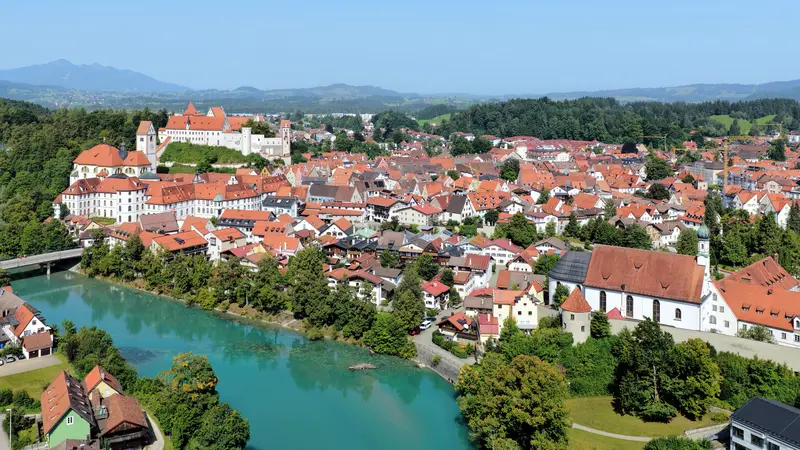
Füssen from Munich: The Town, the Castles and Whether to Stay
Most people race through Füssen on the way to Neuschwanstein and miss the prettiest Alpine old town in Bavaria. Here is how to reach Füssen from Munich, what's worth your time in the town itself, how it gives you the castles, and the honest case for staying the night rather than dashing back.
Read guide