
Bavarian Alps & Castles Loop
Leave Munich for Andechs, Füssen, Neuschwanstein, Linderhof and Garmisch on a four- to six-day Alpine circuit.
- Allow
- 4–6 days
- Route
- 299 km
- Drive time
- 4 hr 21 min
- Stops
- 7
This route puts Ludwig II’s castles back into their landscape. Andechs begins with an abbey above a lake, Füssen provides a real town beyond Neuschwanstein, and the road through the Ammergau Alps joins Linderhof, painted villages and the Zugspitze country around Garmisch.
Castle entry is timed and parking is deliberately outside the monuments. Book first, then shape the drive around those slots; do not arrive from Munich expecting to improvise three major sights before dinner. The route is strongest with two Alpine bases and time for a cable car or lake walk.
The road, in one glance
Pinch or scroll with Ctrl / ⌘ to zoom
Drawing the route…
The route earns
its distance
Each pin is selected as a place to do something—not merely proof that you passed through.
- 01Munich
- 02Andechs Abbey
- 03Füssen
- 04Neuschwanstein & Hohenschwangau
- 05Oberammergau
- 06Linderhof Palace
- 07Garmisch-Partenkirchen & Eibsee
 Photo: Thomas Wolf , www.foto-tw.de · CC BY-SA 3.0 de
Munich
Finish the city on foot and by transit, then collect the car on the morning the Alpine route begins.
Munich (German: München, Bavarian: Minga ) is the capital and most populous city of Bavaria, Germany. As of 30 November 2024, its population was 1,604,384, making it the third-largest city in Germany after Berlin and Hamburg. Munich is the largest city in Germany that is not a state of its own, and it ranks as the 11th-largest city in the European Union (EU).
 Photo: Boschfoto · CC BY-SA 3.0
Andechs Abbey
A pilgrimage church and brewery on the Holy Mountain create a distinctly Bavarian first stop above the Ammersee.
Andechs Abbey is a Benedictine monastery, now a priory but formerly an abbey, in the municipality of Andechs, in the Landkreis of Starnberg, Upper Bavaria, Germany. A place of pilgrimage on a hill east of the Ammersee, the Abbey is famed for its flamboyant Baroque church and its brewery, Klosterbrauerei Andechs, the proceeds from which help fund the monks' mission of help.
 Photo: Wolkenkratzer · CC BY-SA 3.0
Füssen
A compact old town and Lech river setting make the best base for the royal castles rather than a mere parking address.
Füssen is a town in Bavaria, Germany, in the district of Ostallgäu, situated one kilometre from the Austrian border. The town is known for violin manufacturing and as the closest transportation hub for the Neuschwanstein and Hohenschwangau castles. As of 2024-12-31, the town has a population of 15,287.
 Photo: Thomas Wolf , www.foto-tw.de · CC BY-SA 3.0 de
Neuschwanstein & Hohenschwangau
Two royal castles, mountain foothills and the Alpsee form Bavaria’s most famous cultural landscape.
Neuschwanstein Castle is a 19th-century historicist palace on a rugged hill of the foothills of the Alps in the very south of Germany, near the border with Austria. It is located in the Swabia region of Bavaria, in the municipality of Schwangau, above the incorporated village of Hohenschwangau, which is also the location of Hohenschwangau Castle.
 Photo: Wikimedia Commons contributor · CC BY-SA 3.0
Oberammergau
Painted facades, woodcarving and Passion Play history give the Ammer Valley a strong village stop.
Oberammergau is a municipality in the district of Garmisch-Partenkirchen, in Bavaria, Germany. The small town on the Ammer River is known for its woodcarvers and woodcarvings, for its NATO School, and around the world for its tradition of mounting decennial Passion Plays since 1633.
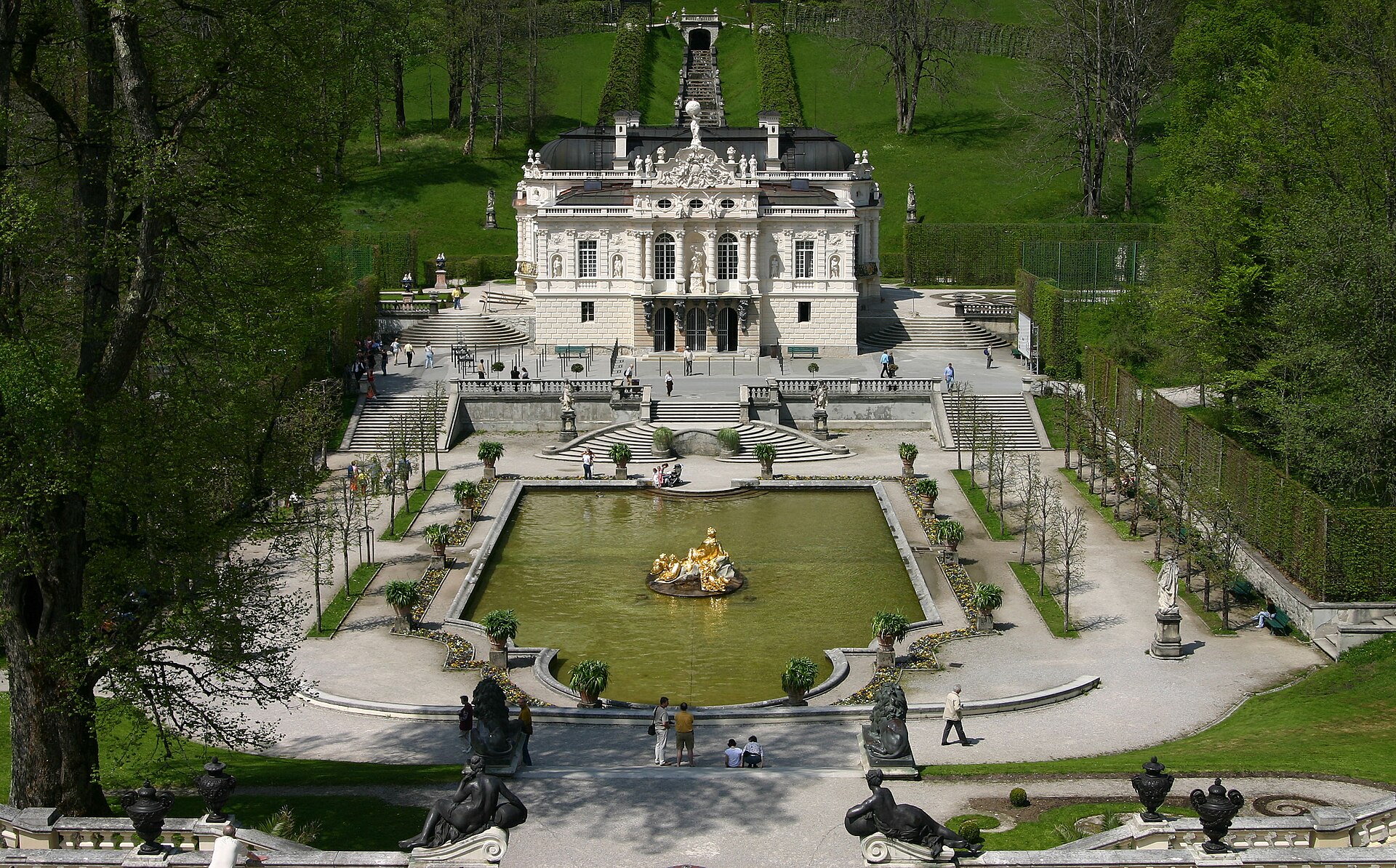 Photo: Softeis · CC BY-SA 3.0
Linderhof Palace
Ludwig II’s intimate palace and formal gardens sit deep in a wooded Alpine valley.
Linderhof Palace (German: Schloss Linderhof) is a schloss in Germany, 10 km west of the village of Ettal in southwest Bavaria. It is the smallest of the three palaces built by King Ludwig II of Bavaria and the only one which was actually completed and that he lived in most of the time from 1876 onward.
 Photo: Octagon · CC BY 3.0
Garmisch-Partenkirchen & Eibsee
Painted lanes, the Zugspitze and a clear mountain lake justify two nights before returning to Munich.
Garmisch-Partenkirchen is an Alpine ski town in Bavaria, southern Germany. It is the seat of government of the district of Garmisch-Partenkirchen (abbreviated GAP), in the Oberbayern region, which borders Austria. Nearby is Germany's highest mountain, Zugspitze, at 2,962 metres (9,718 ft) above sea level.
Drive the conditions,
not the itinerary.
Do not drive into Munich’s center for the city stay. Check winter-tyre rules and mountain conditions, and reserve castle times before choosing the day order.
Checked against
the people who run it
Distances and driving times are planning estimates. Conditions, closures, ferries, permits and park rules can change, so check the linked official guidance before setting out.